

Data Center Demand Hits Record Levels This Year
The industry is balancing huge growth with continuing public skepticism.
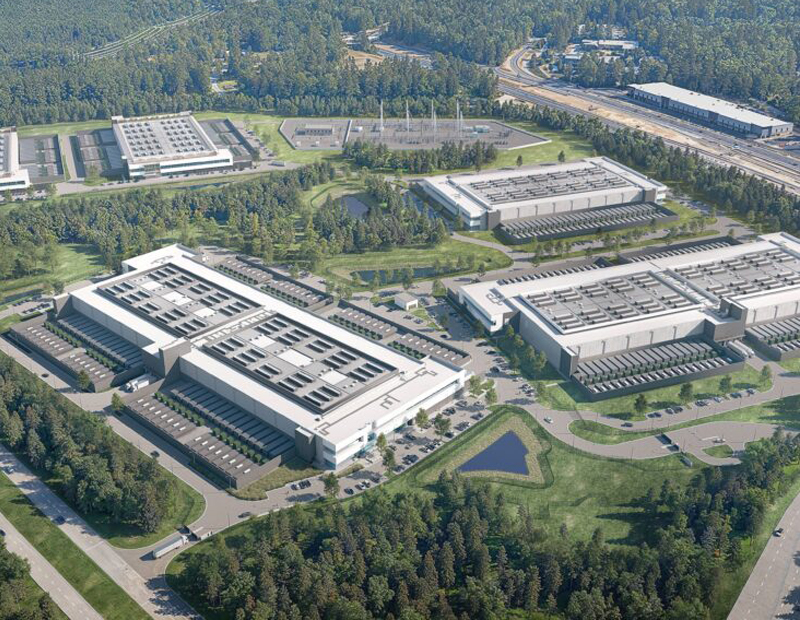
As pushback against the development of data centers intensifies across the country, the industry is seeing unprecedented growth driven by hyperscalers, neoclouds and artificial intelligence companies, with demand doubling year over year, according to JLL’s North American Data Center Report for the first half of 2026.
Absorption for the first part of 2026 reached an all-time high with 25 gigawatts of absorption, double the level from a year ago and five times higher than 2024. Vacancy remained at 1 percent for the third consecutive year despite unprecedented construction activity. North America has 66 gigawatts under construction, with 95 percent of that pre-committed.
“It’s great numbers across all dimensions,” Sean Farney, vice president for data center strategy at JLL, told Commercial Property Executive of the report. “It just shows the strength and resilience of the segment.”
READ ALSO: Has Data Center Development Hit a Wall?
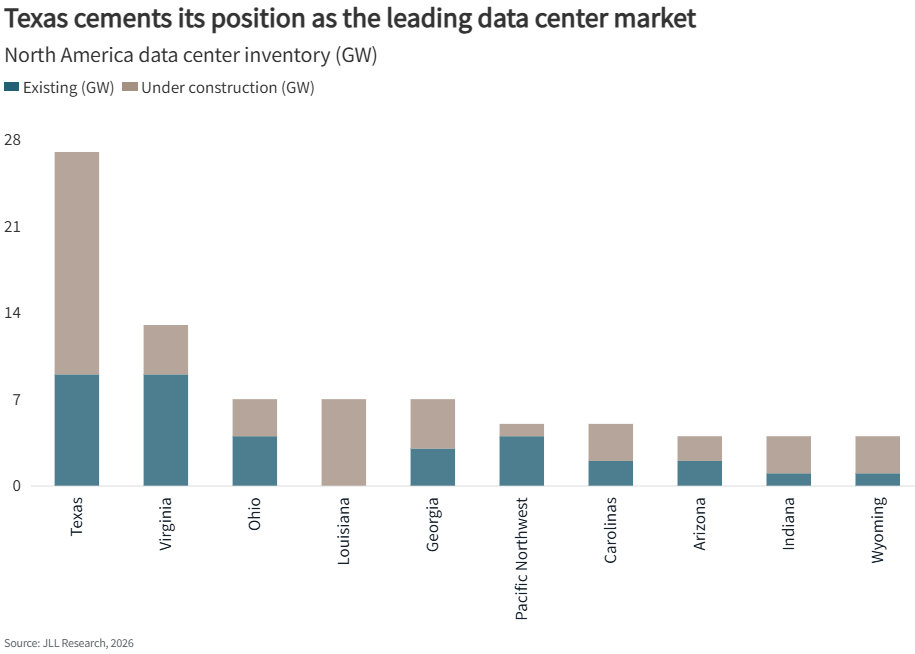
While Virginia remains the world’s largest data center market, Texas is driving new growth this year, with 26 gigawatts of existing and under-construction capacity. Virginia follows at 13 gigawatts. The bulk of new data center development—77 percent—is occurring in what JLL terms the “frontier markets” of West Texas, Ohio, Louisiana, Indiana and the Carolinas. These markets had almost no data center capacity 10 years ago.
Curt Holcomb, vice chair of Global Data Center Solutions at JLL, said in prepared remarks that the firm is seeing a structural shift with sustained low vacancy, landlord leverage and pre-leasing as the new normal for the industry. He noted tenants securing space now are contracting for 2028 deliveries, underscoring how deep and durable the forward demand is.
The supply-demand imbalance is also impacting rents, which have increased by nearly 70 percent since 2020. Rent growth is averaging 9 percent annually, positioning landlords to capture significant spreads at lease expiration, according to the report.
AI adoption impacts supply-demand imbalance
JLL expects to see the vacancy remain near zero through at least 2028, despite the ongoing construction from rapid AI adoption.
Hyperscalers like Microsoft, Amazon, Google, Meta and Oracle continue to drive demand across the industry, accounting for 59 percent of 2026 tenant demand while meeting capacity needs through leasing and self-building. Twenty-eight percent of owner-occupied capacity is currently under construction.
But JLL noted the demand mix is diversifying rapidly, with neoclouds accounting for 11 percent of demand and pure-play AI companies about 7 percent.
Capacity remains a problem, and it’s costly and problematic to wait for new construction to build out, so companies are increasingly forming partnerships to secure infrastructure wherever it’s available. The report noted AI companies are leasing capacity from hyperscalers, while neoclouds are supplying capacity to hyperscalers.
Farney used Microsoft as an example of this growing partnership model. Last year, Microsoft announced a multibillion-dollar agreement with Nebius, a European-based neocloud provider, to build out their AI infrastructure by supplying dedicated GPU capacity and AI computing power to help Microsoft manage AI workloads.
Investor confidence boosts capital market activity
Growing AI development is also impacting the capital markets, with the construction cycle fueling sustained debt demand and high-yield bond issuance reaching $32 billion just in the first half of 2026. The first part of the year also saw AI-related bond issuance surge, with investment-grade issuers generating $218 billion.
Capital markets activity for data center development is reaching unprecedented levels and is robust across all credit tiers. Construction activity is expected to drive more than $700 billion in permanent debt originations over the next 30 months. In another sign of investor confidence, commercial mortgage-backed securities and asset-backed security data center volume reached a combined $17 billion for the first six months of 2026, up 29 percent year-over-year.
Last month, Aligned Data Centers completed a $1.2 billion ABS issuance that was upsized by nearly 30 percent from its original $905 million target due to strong investor demand. The company also broadened its investor base by securing commitments from institutional investors that are both new to Aligned and the data center ABS market.
Calls for industry transparency
Despite all the good news for the data center sector for the first half of 2026, there has been a growing backlash against new developments in recent months. JLL reported that while 79 percent of Americans support U.S. leadership of AI, only 14 percent would support a data center in their own community.

The pushback has been intensifying across the U.S. as local, state and federal governments grapple with concerns raised by residents about potential electricity rate increases, water shortages, expensive tax breaks, noise and air pollution.
While there have been local moratoriums enacted this year, New York became the first state to adopt a moratorium in July, when Gov. Kathy Hochul signed an executive order that applies to projects of 50 megawatts or more. It prohibits the state from providing environmental permits for one year while the state develops a regulatory framework for future data centers.
According to JLL, responsible growth depends on community engagement. The report called on the industry to prioritize transparency around local impacts when projects are proposed.
JLL calls the support gap a “defining challenge for this next phase of growth. The industry and communities need to come together to find a path forward that benefits everyone.”
Farney said it’s important for the industry to combat what he called inaccurate information about data center impacts.
“It’s on us in the industry to do a much better job of putting this information out there for consumption with all the data, because we have it,” Farney told CPE. “We’ve been tracking it for 20 years. We’re the leading asset class around sustainability tracking, power consumption and water consumption.”


You must be logged in to post a comment.