

Exclusive: CBRE Reports a Strong Industry at Midyear
CRE demand remains robust in the face of a complicated economy.
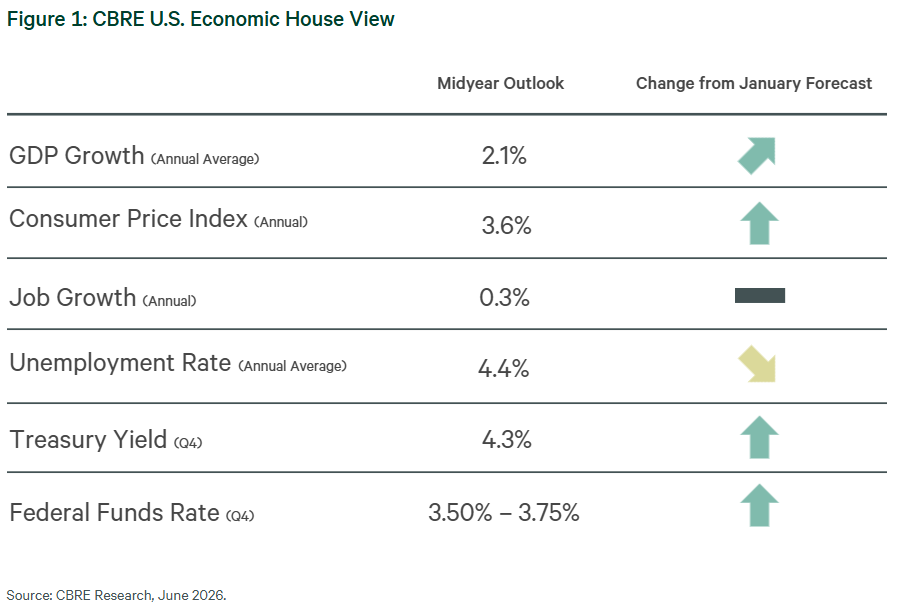
Tensions are thick domestically and internationally, and the U.S. economy is unsettled and prone to inflation, but commercial real estate has so far avoided the malaise prognosticators have been fearing most of this year, according to CBRE’s U.S. Real Estate Market Outlook Midyear Review.
CRE has strong demand going for it, the report noted, including resilient consumer spending, the reshoring of manufacturing, the ongoing build-out of artificial intelligence infrastructure and demographic trends favorable to healthcare.
“In January, we were very positive about the U.S. commercial real estate market, then came conflict in the Middle East, (which) should have had a profound impact on the real estate market in the U.S.,” Henry Chin, CBRE’s global head of research, told Commercial Property Executive. “But the market continued to recover. That was a positive surprise to me.”
Overall resilience
The economy didn’t crater during the first half of the year, but the oil shock gave new life to inflation, just as it was closing in on the Federal Reserve’s 2 percent target. Interest rates have responded, though not the federal funds rate just yet. The 10-year Treasury yield, which CBRE had expected to fall below 4 percent by year-end, will now likely remain above 4 percent, the report points out.
Despite this, the U.S. economy has demonstrated considerable resilience. Supported by an AI investment boom, GDP growth is tracking at 2.1 percent for the year—on par with 2025, CBRE predicts.
READ ALSO: Why CRE Fundamentals Outlast Geopolitics
Against this backdrop, investment activity in CRE remains on track for a 16 percent year-over-year increase to about $605 billion, according to the report. Capitalization rates, which were originally expected to compress modestly, are now projected to hold largely stable for the remainder of the year.
That rate of investment is nearly 4 percent higher than pre-pandemic, Chin said.
“Given a higher 10-year Treasury, with all the noise happening, the transaction value is still back to the pre-pandemic level and 24 percent higher than the first half of last year,” Chin said. “The demand is there, but without much supply coming to the market across all these segments.”
Office and industrial have legs

Office fundamentals continue to normalize, with demolitions and conversions outpacing new completions for the second consecutive year, CBRE reported. Prime vacancy has declined substantially, and tech companies, which are most attuned to AI’s long-term implications, are doubling down on long-term office commitments.
According to CBRE’s 2026 Americas Office Occupier Sentiment Survey, 64 percent of tech companies plan to grow their footprint over the next three years, which bodes well for the U.S. office market.
“Flight to quality continues,” Chin told CPE, noting that gateway markets, like New York or San Francisco, continue to see the most robust growth. Prime vacancy rates have been dropping, and as that space becomes harder to find, spillover demand will come to the non-prime office segment.
Industrial leasing activity is forecast to reach a record annual total of about 1 billion square feet this year—the rough equivalent of the entire metro Chicago industrial market—driven by reshoring of manufacturing operations, third-party logistics outsourcing and tenants leaving behind functionally obsolete space, according to CBRE.
READ ALSO: Why Office Landlords, Tenants Align Interests
Demand may be there, but new supply will remain scarce in the coming quarters. Construction of big-box facilities will likely remain at 10-year lows and first-generation blocks of 500,000 square feet or more may evaporate in a wide variety of key markets, such as Louisville; Greenville, S.C.; Chicago; Phoenix; the Inland Empire; and Kansas City, Mo.
“From the first half of last year, we were worried about the oversupply situation for the industrial logistic facilities, but things have changed rapidly, and the headline is we might see some under-supply situations for the newer facilities in the second half of next year,” Chin said.
Manufacturing, specifically from reshoring and advanced manufacturing, is driving most organic demand, Chin added.
Strange times for data centers
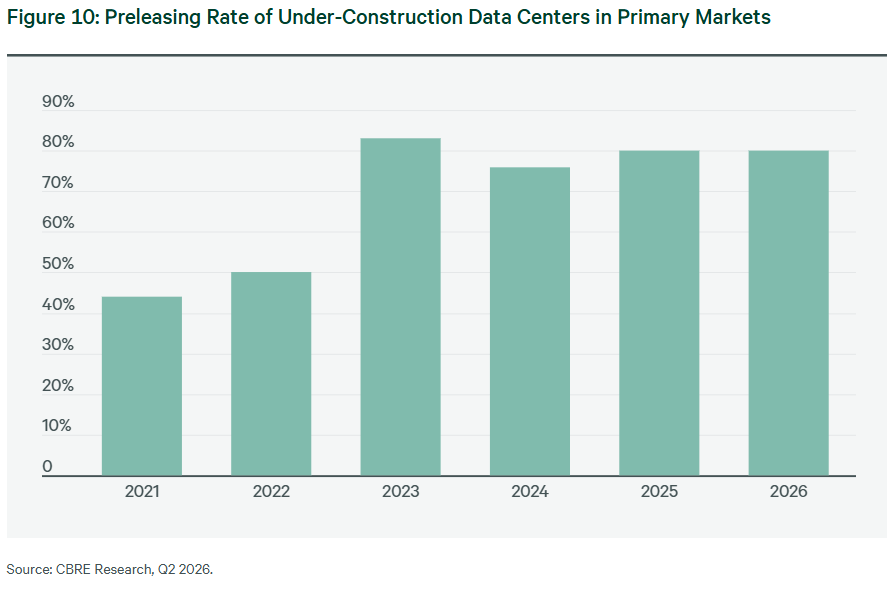
A few years ago, many Americans didn’t know a data center from a date farm, but times have changed. Across the country, public opinion is turning against the development of data centers, and officialdom is considering its course of action. In June, New York Gov. Kathy Hochul signed a first-in-the-nation statewide moratorium on new permits for large data centers, effective for a year.
“If you think about the public opinion to oppose data center development, actually it’s a tailwind for lots of developers and for the existing pipeline,” Chin explained, because the pushback may serve an incentive to push forward. In fact, some markets, such as Texas, are poised to surge, he added.
AI will remain the key driver of data center demand. Connected devices, proprietary AI models and robotics requiring latency sensitive workloads across many sectors are in the very early stages of adoption, CBRE explained.
Power procurement timelines of 10 or more years in some markets are pushing data center developers toward behind-the-meter solutions like natural gas turbines, small modular nuclear reactors and co-location at existing generation sites. These workarounds can shorten timelines to secure power, but electrical equipment backlogs and delays are keeping near-term supply shock risk elevated.




You must be logged in to post a comment.