


Is Bulk Logistics the Next Big Thing?
As supply normalizes, there are advantages of size.

Following an unprecedented post-pandemic development cycle, the U.S. industrial market is entering a new phase characterized by rapidly declining new supply and increasingly differentiated performance amongst various size categories. While the broader industrial sector continues to normalize, bulk logistics facilities exceeding 1 million square feet appear to be emerging as relative leaders, supported by tightening vacancy, structurally resilient occupier demand and sharply reduced development pipelines.
- The supply wave is receding. Industrial construction has fallen to its lowest level in more than a decade, with the development pipeline for 1 million-square-foot-plus facilities declining nearly 70 percent from its 2022 peak.
- Bulk logistics fundamentals are improving first. Vacancy has fallen meaningfully across 500,000 million-square-foot-plus facilities, while smaller warehouse segments continue to experience rising vacancy, signaling a bifurcated recovery.
- Structural demand remains firmly intact. E-commerce, third-party logistics, manufacturing reshoring, automation and supply chain optimization continue to drive demand for modern large-format distribution facilities.
- Market selection is increasingly important. Several major logistics hubs for mega-industrial facilities, including Louisville, Seattle, Nashville, Phoenix, Philadelphia, and Chicago, combine rapidly shrinking development pipelines with improving vacancy trends, which may position them to outperform as the cycle advances.
- Compelling acquisition and development opportunities are emerging. Modern bulk logistics assets continue to trade at attractive values relative to replacement cost, while constrained future supply creates an attractive environment for well-located speculative development to deliver into the next phase of the industrial recovery.

The receding supply wave
The U.S. industrial market is entering a new phase of the supply cycle. Following an unprecedented wave of development during and immediately after the pandemic, new construction has slowed dramatically as the industry works through the excess capacity created by the record building boom. Industrial construction starts totaled just 53 million square feet in the first quarter of 2026, the lowest quarterly level since 2014 and less than half the quarterly average recorded between 2020 and 2023. The economics of new development over the past few years have become considerably more challenging as higher interest rates, tighter construction financing, moderating rent growth, and elevated vacancy in certain markets have caused many developers and lenders to step to the sidelines.
At the same time, construction costs have remained stubbornly elevated, preventing the normal cyclical reset that often follows a slowdown in development activity. According to the Bureau of Labor Statistics, warehouse construction costs remain approximately 48 percent above year-end 2020 levels, reflecting a 7.4 percent annualized increase that has significantly outpaced broader inflation. Unlike previous cycles, demand for labor and materials has remained supported by robust investment in data centers, advanced manufacturingand energy infrastructure, while tariff uncertainty has added further cost pressure and underwriting complexity. Although the pullback in development has been broad-based across virtually every major industrial market, it has not been uniform across segments. As the market moves beyond the post-pandemic supply surge, meaningful differences are emerging.
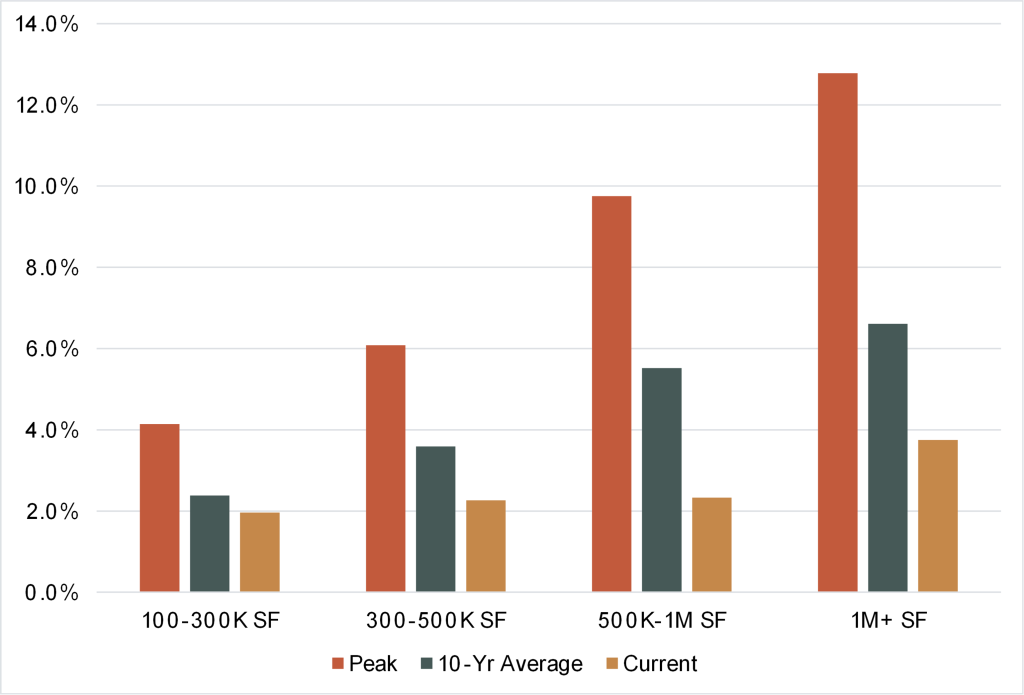
While development activity has slowed across the industrial sector, the decline has been particularly pronounced among the largest logistics facilities. As shown in Exhibit 1, the amount of space currently under construction has fallen most sharply in the 500,000-to-1 million square feet and 1 million square feet plus categories, declining not only from the record levels reached during the post-pandemic development boom but also well below their average share of inventory under construction over the past decade.
Over the past 20 years, larger-format logistics facilities have maintained higher construction levels as a percentage of existing inventory because occupier demand has steadily migrated toward bigger, more sophisticated distribution networks. The rapid expansion of e-commerce, the growing role of third-party logistics providers, and the reshoring and nearshoring of manufacturing have all increased demand for facilities capable of serving regional and national supply chains. Modern logistics operations increasingly favor fewer, larger distribution centers that can accommodate automation, higher clear heights, greater trailer storage and more efficient transportation networks.
EXHIBIT 1: Average net construction unit deliveries, 2026-28 average vs. previous
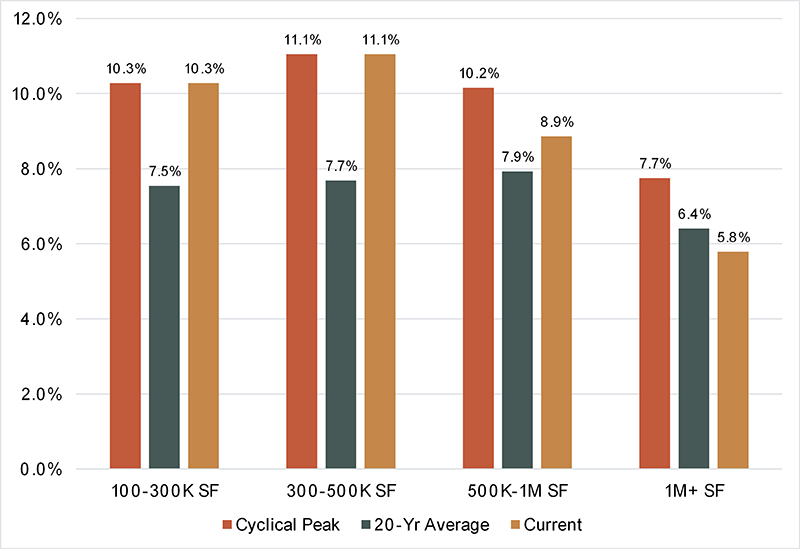
The sharp reduction in new construction is already translating into stronger operating fundamentals for the largest logistics facilities. As deliveries have slowed and occupier demand has remained resilient, vacancy rates have begun to decline meaningfully across the bulk logistics segment. Since peaking in the fourth quarter of 2024, vacancy has fallen by 196 basis points among buildings exceeding 1 million square feet and by 130 basis points within the 500,000-to-1 million square feet category (see Exhibit 2). These improvements suggest that the excess supply created during the post-pandemic construction boom is being absorbed more rapidly than many anticipated.
In contrast, smaller regional distribution facilities have yet to experience a similar inflection point. Vacancy rates within the 100,000-to-300,000 square feet and 300,000-to-500,000 square feet segments have continued to drift higher over the past two years and currently sit at cyclical highs. While fundamentals across the broader industrial market have stabilized, the recovery has become increasingly bifurcated, with the largest logistics facilities separating themselves from smaller warehouse formats.
Perhaps most notable, buildings exceeding 1 million square feet are now the only major industrial size cohort with vacancy below its long-term average over the past 20 years. Historically, vacancy rates below long-term equilibrium have been associated with accelerating rent growth as landlords may regain pricing power and available space becomes increasingly scarce. These rent increases are often more pronounced during periods of rapidly slowing supply, especially for newer product, as demonstrated in our previous research. Although recent rent growth across the broader industrial market has moderated following the extraordinary gains recorded during the pandemic, the largest logistics facilities appear to be entering the next phase of the cycle earlier than the rest of the market, supported by a combination of rapidly declining supply and structurally resilient occupier demand.
EXHIBIT 2: Industrial vacancy rates by segment, current vs. historical
Targeting the next generation of bulk logistics leaders
While the national outlook for bulk logistics has improved, the opportunity is unlikely to emerge uniformly across every market. The concentration of million-square-foot facilities varies considerably across the country, as do development pipelines and vacancy trends. As a result, market and submarket selection will play an increasingly important role in identifying where fundamentals are likely to tighten most rapidly over the next several years.
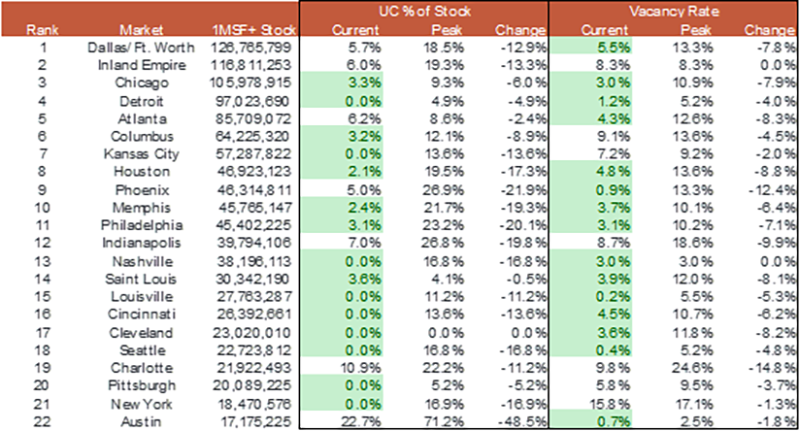
The national development pipeline for buildings exceeding 1 million square feet has already contracted dramatically, falling from approximately 137 million square feet under construction in the third quarter of 2022 to just 43 million square feet as of the second quarter of 2026, a decline of nearly 70 percent. To better identify where the most compelling opportunities may emerge, we evaluated the 22 largest U.S. markets by inventory of 1 million-square-foot-plus logistics facilities (see Exhibit 3). This framework considers both the level and direction of two key indicators: the amount of space currently under construction as a percentage of existing inventory relative to recent peak levels, and current vacancy rates relative to their cyclical highs. Together, these metrics provide a useful gauge of both future supply pressure and the pace at which market fundamentals are improving.
Several markets stand out on both measures. Louisville, Seattle, Nashville, Phoenix, Philadelphia, and Chicago have experienced substantial reductions in construction activity while simultaneously demonstrating meaningful improvements in vacancy. As development pipelines continue to shrink, these logistics hubs appear particularly well positioned to benefit from potential occupancy gains and renewed pricing power.
EXHIBIT 3: Industrial 1 MSF+ market fundamentals & trends
Positioning for the next phase of the cycle
Taken together, the evidence suggests that bulk logistics facilities may be well positioned to benefit from the next phase of the industrial recovery. Development activity has contracted dramatically, vacancy has already begun declining across the largest building categories and many of the nation’s premier logistics markets are experiencing simultaneous improvements in both supply pipelines and operating fundamentals. While conditions will continue to vary by market, the combination of limited future construction and tightening vacancy suggests that many bulk logistics markets may be approaching an environment where landlords regain pricing power and rent growth could begin to accelerate.
Importantly, this backdrop creates opportunities on both the acquisition and development fronts. Although the operating outlook has improved meaningfully, many institutional-quality logistics assets continue to trade at valuations that remain below current replacement cost. Investors, therefore, may have an opportunity to acquire modern facilities at prices that would be difficult to replicate today, while benefiting from what appears to be an increasingly favorable supply-demand environment. Unlike previous periods when investment returns depended largely on aggressive rent growth assumptions, today’s underwriting is generally supported by more disciplined expectations, reflecting moderate rent growth, conservative exit cap rates and stabilized yields that may be achievable through improving fundamentals rather than financial engineering.
The opportunity extends beyond existing assets. In many markets, rental rates for modern bulk logistics facilities already support new speculative development, particularly for larger distribution centers where vacancy has tightened most rapidly. With the national pipeline of 1 million-square-foot-plus facilities having declined by nearly 70 percent from its peak, developers capable of securing well-located, entitled sites today have an opportunity to deliver product into what is likely to be a materially more supply-constrained market over the next several years. Rather than competing against a wave of new construction, these projects may be among the first to deliver during the next expansion phase of the cycle.
This opportunity is particularly compelling because occupier demand continues to evolve toward exactly this type of product. Today’s distribution networks increasingly require facilities capable of supporting automation, robotics, higher electrical capacity, expanded trailer storage and more sophisticated site layouts than were common a generation ago. Retailers, manufacturers, third-party logistics providers and distributors alike are consolidating operations into fewer, larger and more technologically advanced facilities that improve operating efficiency while reducing long-term supply chain costs. As tenants continue investing significant capital into automation and specialized equipment, the premium placed on modern, highly functional logistics facilities is likely to widen further.
Mark Fitzgerald is managing director & head of research for Affinius Capital. Lange Allen, partner & head of North American industrial; Jason Hans, senior managing director of industrial portfolio management; and Sandra Gurrola, research analyst, contributed to the creation of this article.
Please note: To become a Viewpoint writer, reach out to Therese Fitzgerald at therese.fitzgerald@cpe-mhn.com. All Viewpoints are copyright of Commercial Property News 2026. We do not accept AI-written content.


You must be logged in to post a comment.