

Return-to-Office Growth Slows in April
Most markets are still growing—especially on the West Coast—according to Placer.ai.
Workers are still visiting their offices in person more than at any time since the pandemic, but the rate of increase for office visits slowed in April 2026 compared with the month before, according to the latest Placer.ai Office Index.
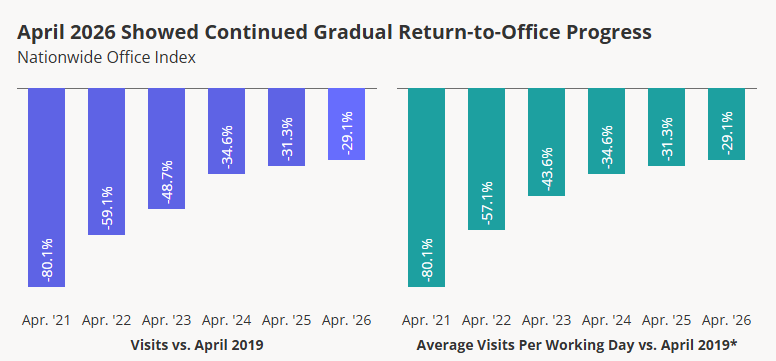
Nationwide, office visits in April 2026 were 29.1 percent below April 2019 levels, a 2.2 percentage point gain from April 2025, when visits were 31.3 percent below 2019. Though still growth, it is not as much as in March 2026, which enjoyed a 4.2 percentage point gain compared with 2019, the report found.
“Office trends in April 2026 showed a softening of in-office work compared to the previous month, potentially spurred by rising fuel costs across the country,” Placer.ai Director of Research Elizabeth Lafontaine told Commercial Property Executive. “High gas prices may deter those commuting to the office by car.”
In April, the national average for a gallon of gas surpassed $4 for the first time since 2022, due to the disruption of the world oil market by the war with Iran. For workers already facing high commuting costs, a jump of more than $1 per gallon in a single month is a significant headwind, according to Placer.ai.
READ ALSO: How Global Investors Are Adjusting to Disruption
“While we have observed continued improvement compared to 2025 levels, economic headwinds and labor market changes may pressure office trends in the coming months,” Lafontaine told CPE.
However, there are still tailwinds when it comes to return-to-office growth, Placer.ai noted. RTO mandates are still fairly common, for one thing. Also, a MyPerfectResume survey early this year, cited by Placer.ai, found that just 7 percent of employees would quit outright over a mandatory RTO policy in 2026—down from 51 percent in January 2025.
Employees have gotten the memo from the labor market: hiring is down and open positions are fewer. That labor market softening has left workers with less leverage to push back on policies they might have resisted just a year ago.
LA, San Francisco Continue RTO Growth
Most of the 11 office markets tracked by Placer.ai for its index posted modest year-over-year visit growth, led again by Los Angeles and San Francisco, up 5.7 percent and 5.4 percent, respectively. San Francisco, hard hit by the pandemic in terms of office visits, is seeing an AI industry-powered recovery.
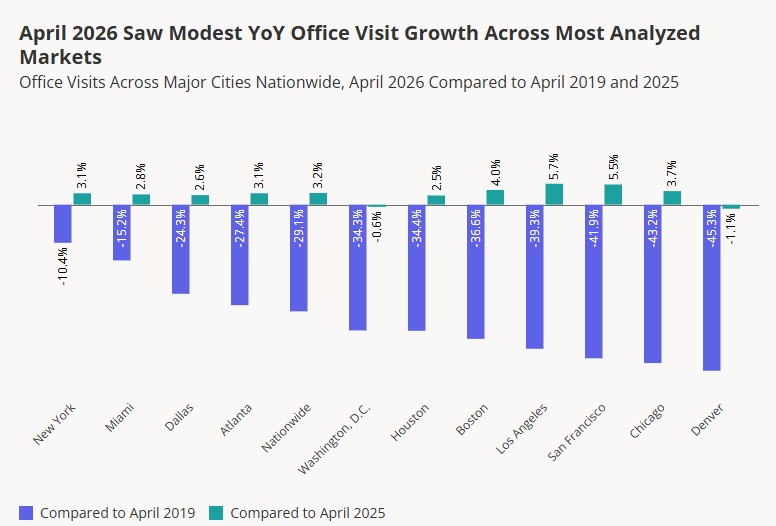
Though improving at a faster clip than any other markets, Los Angeles and San Francisco are still lagging compared with 2019, with both still down more than 40 percent. The strongest RTO compared with 2019 is New York City, down only 10.4 percent, followed by Miami at 15.2 percent down.
Two markets went retrograde in terms of office visits in April, with Denver down 1.1 percent from a year ago, and Washington, D.C., down 0.6 percent over the year, according to Placer.ai data. Compared with 2019, Denver is at the bottom of the list, down 45.3 percent.
Placer.ai notes that Denver has “one of the most remote-friendly labor markets in the country,” and that its downtown office vacancy is still around 38 percent. Even so, prime and Class A buildings remain a bright spot for RTO, as Denver employers look to draw workers back with higher-quality spaces instead of mandates alone.
The index analyzes foot traffic data from some 1,300 U.S. office buildings, including newer buildings that were at least partially leased from the end of 2019. Besides pure office assets, there is data from office buildings with first-floor retail components, but not mixed-use residential and commercial, or government buildings.


You must be logged in to post a comment.