


Austin Office Pipeline Outpaces Peers
This market is seeing a slowdown in transactions while vacancy stays elevated, Yardi Matrix data shows.
Austin’s office market opened 2026 with mixed signals. Transaction activity remained muted through the first two months of the year, while vacancy stayed elevated—even after a meaningful year-over-year decline—keeping fundamentals under pressure relative to most peer metros.
At the same time, development metrics continued to stand out. Austin maintained a comparatively active construction pipeline and a sizable share of projects in planning, even as deliveries were limited early in the year. Asking rents remained well above the national average, and the metro’s coworking footprint continued to expand modestly, positioning flex space as a growing slice of its office inventory.
Additionally, in 2025 Austin leaned on state-level policy changes to address its elevated office availability. One key measure, Texas SB 840, is intended to speed housing production by allowing office and retail properties to be converted into mixed-use or residential without lengthy rezoning processes. Still, because much of Austin’s inventory is relatively new, conversion activity—and the near-term pipeline it could generate—may remain limited.
Austin’s office pipeline surpasses peer metros
Austin’s office development pipeline as of February clocked in at 976,979 square feet, representing 1 percent of its total stock. This figure was above the 0.4 percent average and peer markets such as Atlanta (0.2 percent), Phoenix (0.3 percent) and Dallas (0.8 percent).
On a national level, Austin’s pipeline was among the top 10 metros for office development, ranking eights after leaders Boston (3.9 million square feet), Manhattan (2.7 million square feet) and Dallas (2.3 million square feet). When also taking into account projects in planning stages, Austin’s share clocked in at 2.9 percent, ranking third nationally. Boston (5.3 percent) led the U.S., with more than triple the 1.5 percent national average.
Apple is currently working on expanding its Austin campus. The company is adding 573,402 square feet of office space to its almost 1 million-square-foot complex. Upon completion, the development will have five buildings.
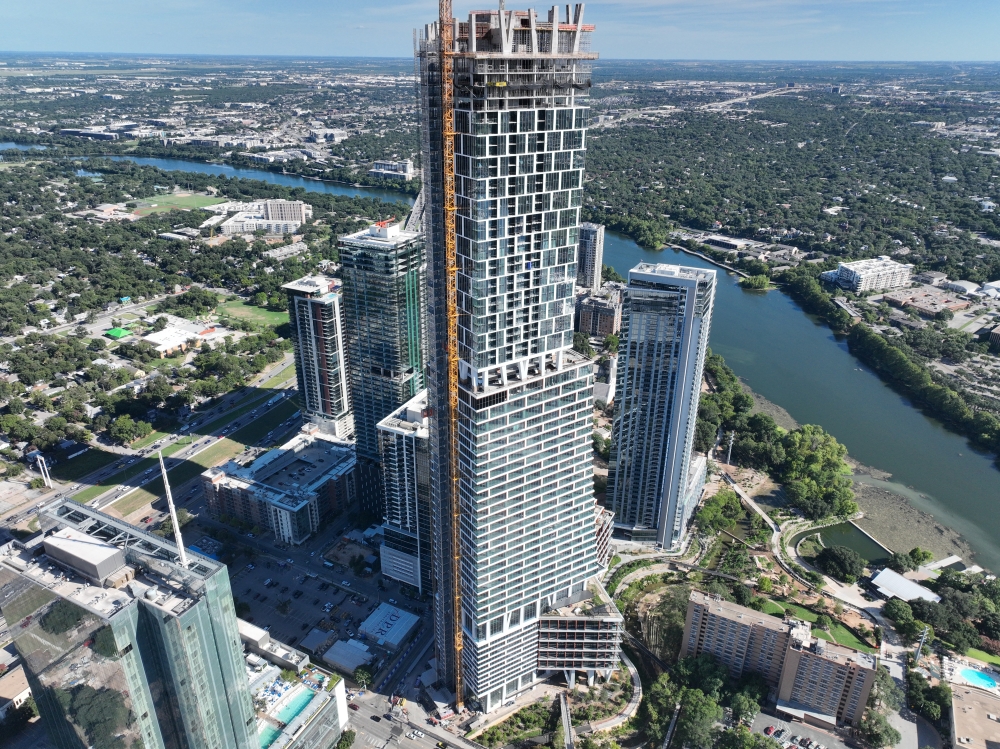
In terms of office deliveries, only two properties totaling almost 51,000 square feet came online as of February. This figure, however, is set to grow as more projects are scheduled for delivery. One of them is Lincoln Property Co. and Kairoi Residential’s Waterline, the tallest building in Texas. The 74-story tower will have 2.7 million square feet and include office, residential and hotel space.
Office investment volume remains muted
Austin’s office investment activity remained slow at the start of the year, with transactions scarce through the first two months of 2026. Sales volume did not reach the $50 million mark over that period, pointing to continued caution among buyers and limited deal flow.

The metro’s 2025 totals also trailed several peer markets. Austin recorded $628 million in office sales last year, behind Phoenix ($1.3 billion), Atlanta ($1.4 billion) and Dallas ($3 billion). Even so, pricing held up, with an average of $216 per square foot, above the $192 national benchmark.
One of the assets that changed hands last year is Cielo Center, a three-building office campus within the West Lake Hills suburb. A joint venture between AQUILA Commercial and Serpa Partners purchased the 286,000-square-foot complex from Starwood Capital Group.
Austin’s office vacancy remains high
Austin office space recorded a vacancy rate as of February clocked in at 24.6 percent, making a 290-basis-point year-over-year decrease. However, its figure was the second largest nationally, being surpassed only by Seattle (25.1 percent).
The U.S. average clocked in at 17.6 percent. Peer markets such as Phoenix (17 percent) and Atlanta (17.9 percent) were at the opposite end of the spectrum.
Austin’s average listing rate during the same month was $46.38, well above the $32.79 national index. The metro ranked fifth nationally, with only gateway markets faring better. Atlanta ($36.64) and Phoenix ($29.83) commanded lower prices. Additionally, the metro had one of the highest asking rents in the South.
Flex office footprint continues to expand
Austin’s coworking inventory totaled roughly 2 million square feet across 108 locations as of February, representing 2 percent of the metro’s office stock, according to CoworkingCafe. The share increased by 20 basis points from the footprint reported in the previous market update.
The metro’s flex office inventory was larger than that of Charlotte (1.8 million square feet) and Orlando (1.5 million square feet), but it continued to trail peer markets Phoenix (3.4 million square feet), Atlanta (2.2 million square feet) and Dallas (6.7 million square feet).
WeWork remained Austin’s largest provider as of February, with 298,149 square feet across five locations. It was followed by Industrious (210,446 square feet), Regus (184,024 square feet) and Expansive (160,245 square feet).

You must be logged in to post a comment.