

Commercial Property Operators’ Monthly Action Plan
A month-by-month guide to keeping your commercial properties running smoothly, covering maintenance, tenant relations and seasonal priorities.
When it comes to maintaining commercial properties, the devil is certainly in the details—especially since many of those details change with the season and include a wide variety of tasks. Not to mention that even needs within the same portfolio can vary by location, and every new member of the property team must be on top of them if you want to maintain a consistently high level of service.
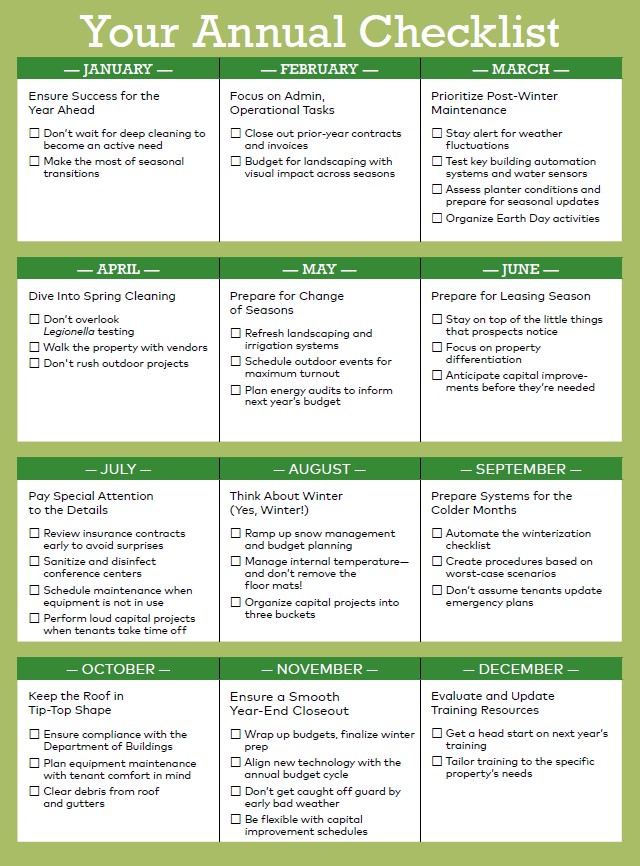
To aid in this effort, CPE created this handy action plan, with checklists organized by both month and season. It includes not only key tasks to remember but critical details and advice from some of the best in the biz. Use it as a standalone resource or incorporate the ideas and advice into your existing guidelines to help up your management game.
Year at a Glance: The Communication Essentials
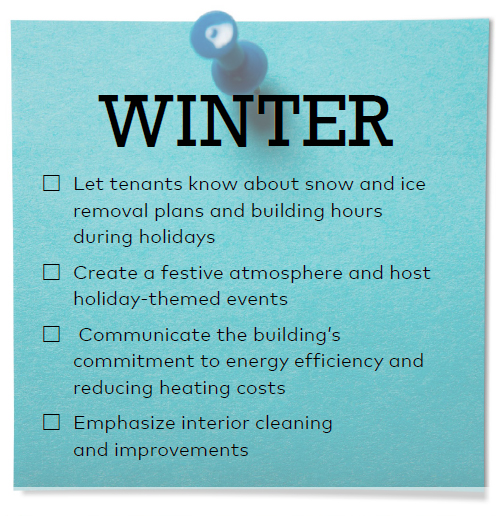
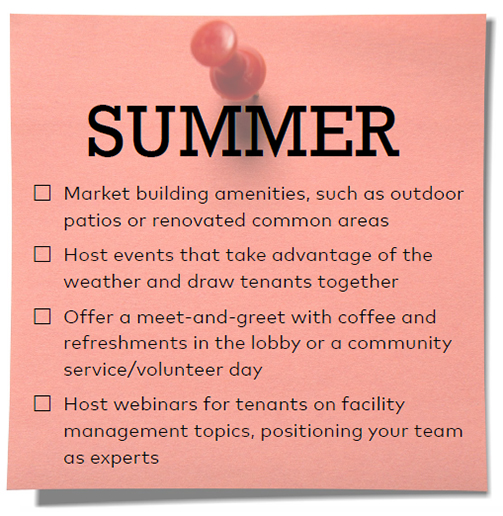
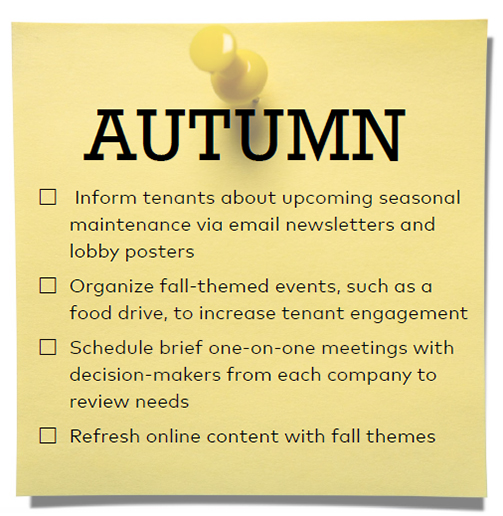
Successful commercial property management teams prioritize staying in touch with tenants. A seasonal checklist makes it easy to build rapport and trust as return-to-office mandates clock in. Share important information on the website, on social media channels and through newsletters.
Notes:
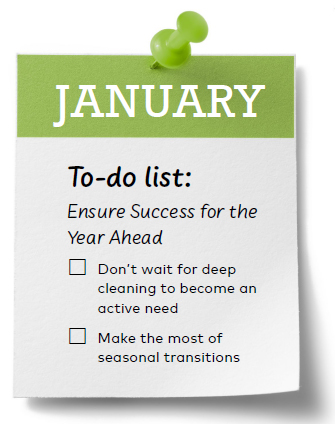
Don’t wait for deep cleaning to become an active need
Deep cleaning isn’t just an annual occurrence, it’s a maintenance necessity that must be addressed as often as required. Carpets and windows should be cleaned quarterly.
High dusting is done monthly. Restrooms are cleaned daily.
When it comes to annual maintenance, we make sure required filter changes are carried out for air handling units and/or supplemental units to ensure the highest level of indoor air quality during winter. Exterior windows are examined for any penetration of cold or wind. Elevator doors are inspected to ensure proper lubrication. If needed, induction units are cleaned.
—Jeremy Voigtmann, Managing Director of Construction and Commercial Management, Harbor Group International
Make the most of seasonal transitions
A helpful seasonal tip for office property owners is to use this time to align on goals and revisit lessons learned from previous seasons. Whether it’s preparing for winter weather or refreshing curb appeal in spring, seasonal transitions are a great opportunity to ensure your team is on the same page.
—Jona Schmidt, Senior Vice President, Transwestern
Our best tip? Keep the building clean all year long and don’t wait to do a deep clean.
—Jeremy Voigtmann, Harbor Group International
Notes:
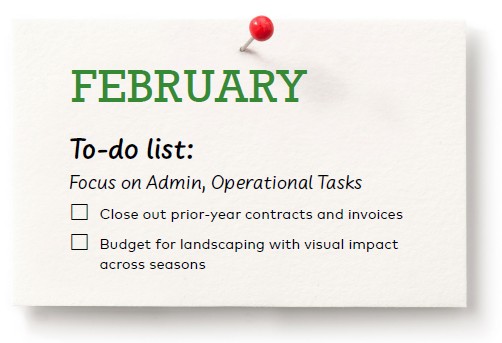
Close out prior-year contracts and invoices
In February, property management teams should focus heavily on administrative and operational closeout tasks while beginning to prepare for spring. This is when managers complete prior-year financial activities—closing out contracts and invoices and conducting CAM reconciliations. Operationally, teams can plan for upcoming seasonal work such as exterior power washing, flower and plant rotations, and garage or parking lot sweeping to remove winter salt.
Engineering teams can use this window to complete pre-cooling season maintenance and smaller HVAC projects before cooling demand increases. Managers can review capital projects, confirm contractor pricing and delivery schedules, and start mapping out bid and contract timelines for any budgeted work that isn’t already on annual contracts.
—Kevin Whalen, Senior Managing Director & Mid-Atlantic Asset Services Leader, Cushman & Wakefield
Budget for landscaping with visual impact across seasons
Budgeting-wise, one creative way to reduce operating costs is through strategic landscaping. We prioritize installing focal points—like hardy perennials or structural features—that provide visual impact across multiple seasons. Then, we supplement with lower-cost, seasonal accents to keep things fresh without overspending. This layered approach helps maintain a polished look year-round while staying budget conscious.
—Jona Schmidt, Senior Vice President, Transwestern
Notes:
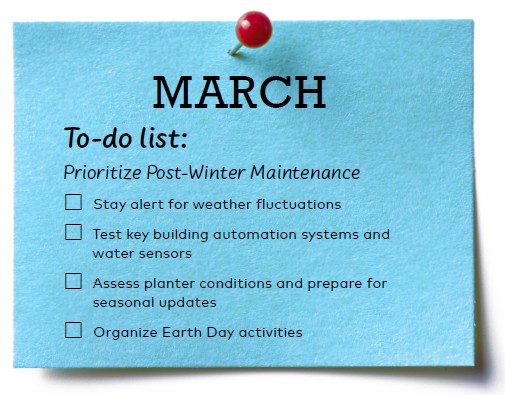
Stay alert for weather fluctuations
A particular challenge arises during the shoulder months, such as March and November. During these times, our building management system and HVAC system require more hands-on monitoring due to temperature fluctuations and the switch-over of building systems, which can vary day-to-day or week-by-week in places like New England.
—Mether Eldred, General Manager of Life Science, Hobbs Brook Real Estate
Test key building automation systems and water sensors
Test irrigation for general leaks and smart water sensing technology for proper function. Inspect lighting photocells, building automation systems and time clocks for proper lighting function and timing. Examine walkways, garages and parking lots for damage, especially in climates with extreme weather. It’s also good to evaluate pressure washing and window cleaning needs in the spring.
—Karen Whitt, President of U.S. Real Estate Management Services, Colliers
Assess planter conditions and prepare for seasonal updates
In March, teams should begin inspecting outdoor areas for any damage that was caused by winter weather—such as broken branches, salt damage, soil erosion or cracked hardscaping.
Although I’ve worked in more urban environments with limited landscaping, early spring is still a critical time to assess planter conditions and prepare for seasonal updates. We begin landscaping design and plant selection a few months earlier, especially since we manage many planters. This requires placing sizable orders with suppliers in advance to ensure they have time to grow and deliver the necessary plant material.
—Jona Schmidt, Senior Vice President, Transwestern
Organize Earth Day activities
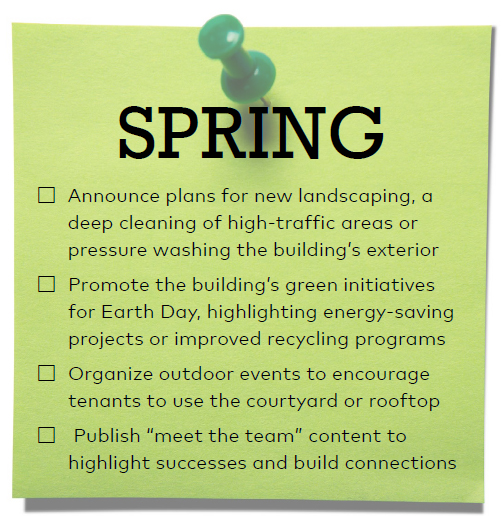
Spring is an ideal time to organize property clean-ups and sustainability initiatives, such as electronics recycling, Earth Day activities, ESG awareness campaigns and volunteer events.
—Kevin Whalen, Senior Managing Director, Cushman & Wakefield
(In urban environments) we begin landscaping design and plant selection a few months earlier, especially since we manage many planters.
—Jona Schmidt, Transwestern
Notes:
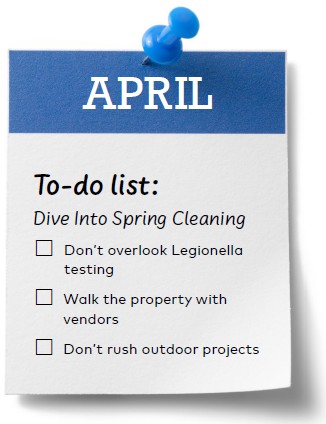
Don’t overlook Legionella testing
Always take care of preventive maintenance on A/C equipment: filter changes for main and supplemental units, bearing lubrication, cooling tower cleaning, chiller tube cleaning, Legionella testing and similar. Clean exterior windows if needed, check exterior water spigots to make sure they are operational and conduct a general spring cleaning to keep the office organized.
—Jeremy Voigtmann, Managing Director, Harbor Group International
Walk the property with vendors
Property teams should ensure equipment such as pressure washers in the spring and snowblowers in the fall are working properly prior to needing them. Stock is often limited when a storm or event takes place. Meeting with snow removal vendors to walk properties and align on expectations prior to winter is also recommended, especially if they are a new vendor. Walking the snow removal vendor through the property will reduce excessive costs, injury risks and property damages.
—Karen Whitt, President of U.S. Real Estate Management Services, Colliers
Don’t rush outdoor projects
Exterior maintenance projects are trickier to schedule and predict due to weather conditions, so we generally avoid starting outdoor projects until after March and aim to complete them before the end of October. This approach allows us to better plan staffing and manage any weather-related considerations.
—Mether Eldred, General Manager of Life Science, Hobbs Brook Real Estate
Notes:
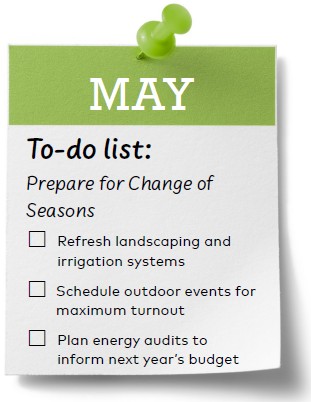
Refresh landscaping and irrigation systems
We make sure all HVAC systems are inspected, filters are replaced and everything is running efficiently to handle the summer heat. The exterior of the building is also reviewed. Roofs, drains and windows are checked for any damage or debris left from winter.
Landscaping and irrigation systems are refreshed and adjusted for the season, and we step up pest control efforts, as activity tends to increase with warmer weather. We also make sure all life safety systems are working properly and that the building is comfortable and well-prepared for tenants as we transition into summer.
—Lady Diggs, General Manager of Property Management, CBRE
Schedule outdoor events for maximum turnout
Schedule large outdoor tenant events after the rainy season—but before or after the summer break—to get a high level of participation from tenants’ employees.
—Jim Proehl, Principal & Senior Director, Avison Young
Plan energy audits to inform next year’s budget
May marks the transition into summer and is the right time for property teams to begin hurricane preparedness, as the season officially starts on June 1. Managers confirm vendor readiness, communicate with restoration companies and review emergency procedures. It’s also a key period for conducting or planning energy audits—often scheduled to allow for audit findings to inform next year’s capital or operating budgets.
On the maintenance side, teams complete cooling tower cleaning and other summer-readiness tasks while repairing any residual damage from winter, such as cracked pavers or landscaping wear. Capital projects such as equipment replacements, amenity enhancements and groundswork are typically underway by this time, while budgeting and reforecasting also take shape as teams gather pricing for upcoming work.
—Kevin Whalen, Senior Managing Director, Cushman & Wakefield
Notes:
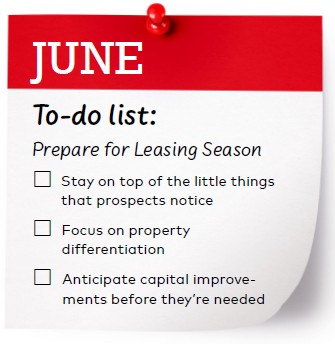
Stay on top of the little things that prospects notice
Late spring to early fall is the most active time for commercial real estate leasing. It’s important to focus on the little things. Shoulder seasons in certain regions can come with leaves or roots clogging drains or covering landscaping. Appearance and function of the property are crucial to prospective tenants. These seasons often come with extreme temperature fluctuations, so staying on top of internal comfort and appearance is also important.
—Karen Whitt, President of U.S. Real Estate Management Services, Colliers
Focus on property differentiation
One of the first things we focus on is differentiation—making sure our property stands out visually. Landscaping can play a big role in this, especially since it’s one of the first impressions during a tour.
While the partners we work with may also work on other buildings in our market, we request unique alternatives to what other properties have standardized. We walk the tour route in advance to ensure everything is in order, from curb appeal to cleanliness and signage.
We also coordinate with teams to refresh common areas, update marketing materials and ensure leasing staff are aligned on messaging and goals. The overall goal is to create a seamless, polished experience that reflects the value of the asset.
—Jona Schmidt, Senior Vice President, Transwestern
Anticipate capital improvements before they’re needed
Start bringing in any needed contractors several months before doing the annual budget. Get a good handle on the numbers—what’s a $50,000 or $200,000 project—so you are prepared for the budget. You can even look three to four years out for interior upgrades and capital improvements. Some of those get very expensive, and building owners will want to know ahead of time.
Don’t miss any spots: elevators, roofs, mechanical. Have an idea what age they are. It’s running properly now, but that could change. Capital costs can get extremely high. The bottom line and those NOIs are becoming a lot more important to owners because the expenses are continually going up.
—Scott Vyskocil, Senior Vice President, NAI FMA Realty
Notes:
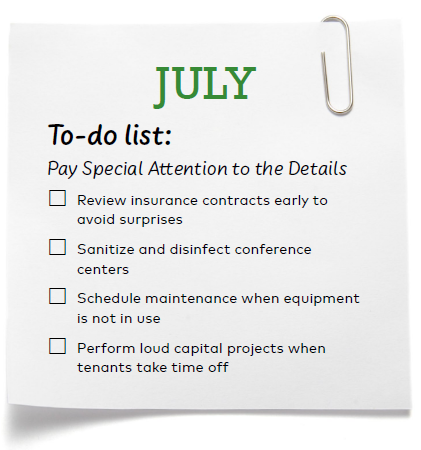
Review insurance contracts early to avoid surprises
There have been significant jumps in insurance rates all over the country. This has been taking some building owners a little bit by surprise, since insurance never used to be that big of a line item on the balance sheet. The larger the commercial property, the earlier you should start reviewing annual insurance contracts—as early as four to six months ahead of time. You’ll want to start talking to the insurance broker in July or August so you can understand what’s coming and budget accordingly.
Have the insurance company come through and do a review of the buildings. Stay in contact with your insurance broker and keep picking their brain on what they’re seeing across the country. You can also stay ahead by inviting insurance experts to speak at local industry events.
—Scott Vyskocil, Senior Vice President, NAI FMA Realty
Sanitize and disinfect conference centers
We work closely with our janitorial team to perform deep cleaning throughout the building’s common areas. This includes cleaning all furniture and carpeted floors. All conference center spaces are thoroughly sanitized and disinfected, with special attention given to frequently touched surfaces. Also, all common-area restrooms go through comprehensive deep cleaning, including scrubbing floors, grout, walls and partitions.
—Lady Diggs, General Manager of Property Management, CBRE
Schedule maintenance when equipment is not in use
During the warmer months, we focus on exterior projects and any work that requires warm weather. For instance, in the summer our team diligently performs preventive maintenance on the boilers while they are turned off. Conversely, in the winter, we focus on upgrading chillers and enhancing cooling systems.
—Mether Eldred, General Manager of Life Science, Hobbs Brook Real Estate
Perform loud capital projects when tenants take time off
During the summer months, many of the tenants’ employees are scheduling vacations. This is when the disruption from loud capital projects will impact fewer occupants so address those issues now to minimize noise complaints.
—Jim Proehl, Principal & Senior Director, Avison Young
All conference center spaces are thoroughly sanitized and disinfected, with special attention given to frequently touched surfaces.
—Lady Diggs, CBRE
Notes:
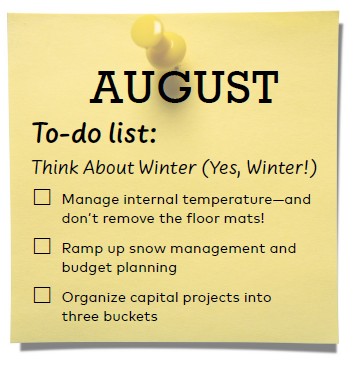
Manage internal temperature—and don’t remove the floor mats!
Draw shades during summer months to help keep the building cool so you’re not as reliant on costly cooling systems. Keep umbrella stands and floor mats available year-round—they’re good for rain, too!
—Jeremy Voigtmann, Managing Director, Harbor Group International
Ramp up snow management and budget planning
August is a planning-heavy month, as property teams begin preparing for both winter and the new budget year. Snow and ice management planning ramps up, with bids for snow removal contracts issued for October execution. Managers also order and stock winter supplies such as ice melt, generator fuel and cold-weather gear.
At the same time, irrigation systems are scheduled for winterization, and final landscaping rotations for the year are planned. Many properties are in full budget season, gathering pricing for next year’s projects and incorporating leasing assumptions into their forecasts. For office and mixed-use assets, this is also when holiday decorations and tenant event planning begin.
—Kevin Whalen, Senior Managing Director, Cushman & Wakefield
Organize capital projects into three buckets
Capital upgrade planning is evolving rapidly, with investor clients and asset managers requesting annual capital budgets earlier each year. What once occurred in late fall now begins as early as August, requiring property managers to accelerate their planning cycles and deliver more comprehensive proposals.
The key to successful capital planning lies in strategic categorization. Organize capital projects into three distinct buckets: deferred maintenance for critical equipment failures and essential upkeep; capital supporting leasing activity that drives revenue and tenant retention; and discretionary improvements that enhance long-term building value. This framework enables asset managers to navigate approval processes more effectively by clearly distinguishing between must-do expenditures and strategic investments.
—Mike Parlato, Executive Managing Director, JLL
Notes:
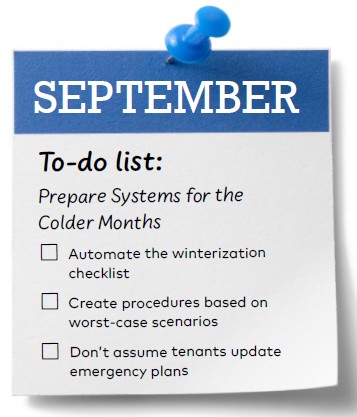
Automate the winterization checklist
Automate and track a detailed winterization checklist that focuses on internal and external systems. Examples include mechanical equipment, grounds (irrigation), fire life that’s exposed to the elements (dry sprinkler piping). Keep this checklist in a computerized maintenance management system such as a work order system. Set it up as a preventive maintenance task annually.
—Karen Whitt, President of U.S. Real Estate Management Services, Colliers
Create procedures based on worst-case scenarios
Winterization procedures begin in the fall to ensure the property runs efficiently through the colder months. Proactive measures help safeguard the property, reduce risk and ensure a safe and comfortable environment.
We ensure all critical equipment maintenance is performed on essential winter equipment—including boilers, heating systems, snow removal tools and emergency generators—to prevent breakdowns during peak usage. We confirm that we have spare parts for longer lead-time items and that all third-party contracts are current.
Our engineering and security teams participate in annual cold weather training to review protocols, emergency procedures and best practices for maintaining safety and operational continuity.
—Jona Schmidt, Senior Vice President, Transwestern
Don’t assume tenants update emergency plans
Each part of the country has its own issues, from tornadoes to rail derailments to earthquakes. Remind tenants to do an annual review of their emergency plans. They need to make sure that everything’s current, including procedures for gathering spots and how to safely exit the building. As tenants get new people in—and they have turnover in the office—they all need to be on the same page.
—Scott Vyskocil, Senior Vice President, NAI FMA Realty
Notes:
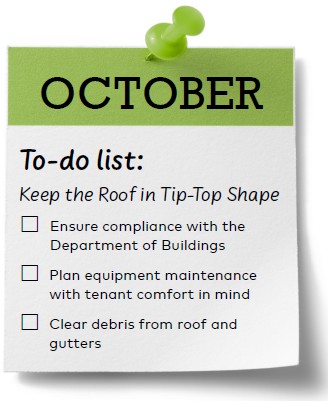
Ensure compliance with the Department of Buildings
We have a contractor inspect the roof and inspect and clean the drains. We make any repairs needed based on the contractor’s report, ensuring compliance with the Department of Buildings. We clean all roof drains quarterly and proactively clean them prior to any heavy rains. This can happen in the fall or spring. It’s important to have a water-tight roof at all times and keep it clean of trash or unwanted vegetation.
—Jeremy Voigtmann, Managing Director, Harbor Group International
Plan equipment maintenance with tenant comfort in mind
As the colder months approach, our attention shifts to indoor projects, particularly maintaining and upgrading our HVAC equipment. Our dedicated team works collaboratively to ensure these activities are meticulously planned and executed, minimizing any disruption to tenant comfort.
By scheduling maintenance of cooling equipment during the winter, we effectively avoid unnecessary downtime and maintain efficient building systems throughout the year.
—Mether Eldred, General Manager of Life Science, Hobbs Brook Real Estate
Clear debris from roof and gutters
We coordinate a full roof inspection to make sure the building is ready for winter. Our team and roofing vendor look for any wear or damage from the summer, checking seams, flashing, drains and overall roof conditions. We clear away all debris from the roof and gutters to prevent standing water and potential leaks once the weather turns.
We also verify that the roof anchor system and equipment are compliant and in good working order for safety. Any minor issues we find are repaired right away to prevent bigger problems later. Doing this helps extend the life of the roof and keeps the property well protected through the colder season.
—Lady Diggs, General Manager of Property Management, CBRE
Notes:
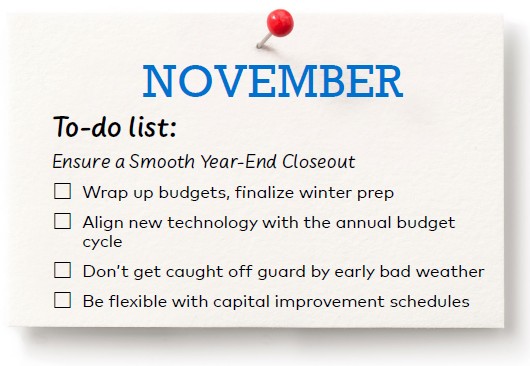
Wrap up budgets, finalize winter prep
November is all about readiness for winter and the year-end closeout. Property teams should ensure all heating systems and pipes are insulated, generators are tested and vacant suites are prepared to withstand colder temperatures. Roof inspections should be completed to check for leaks, debris and snow load capacity, and repairs to roof systems or solar installations finalized.
Financially, managers need to wrap up budgets, issue estimate letters for the following year, and complete reconciliations and accruals to ensure a smooth year-end. This is also a time for ESG initiatives and safety planning—send out winter readiness checklists, confirm emergency contact trees and review operational procedures. You might want to plan tenant holiday events as the final touch to close out the calendar year.
—Kevin Whalen, Senior Managing Director, Cushman & Wakefield
Align new technology with the annual budget cycle
View technology as a critical tool for enhancing customer satisfaction and constantly assess how new solutions can improve the experience. While our evaluation is continuous, any new technology implementations and their associated costs are strategically planned to align with the annual property budget cycle.
—Gregory Carey, Chief Information Officer, The RMR Group
Don’t get caught off guard by early bad weather
Heading into the winter, we check our snow removal equipment and ice melt and snowblower gas supply so we’re not caught off-guard by an early winter snowstorm.
—Jeremy Voigtmann, Managing Director, Harbor Group International
Be flexible with capital improvement schedules
Collaborate closely with the client during their budgeting season to determine the timing of capital projects. Although they are scheduled in the budget, projects may be delayed based on the asset’s financial performance. Capital projects are frequently pushed back later in the year, which is why typically over 50 percent are completed in the last four months even if they are budgeted evenly throughout the year.
—Jim Proehl, Principal & Senior Director, Avison Young
Property teams should ensure all heating systems and pipes are insulated, generators are tested and vacant suites are prepared to withstand colder temperatures.
—Kevin Whalen, Cushman & Wakefield
Notes:
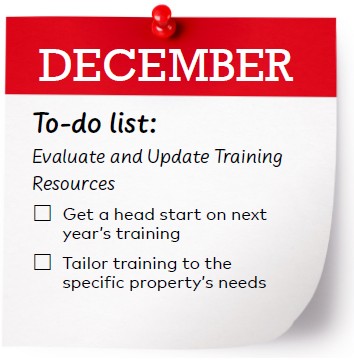
Get a head start on next year’s training
We start with evaluating our annual new-hire training, ensuring we explain our company mission and how to navigate systems and resources. We then evaluate and evolve our internal and external training resources for each service line. This includes technical development, operational training and safety lessons. Training needs often change depending on industry trends or world events, so having a flexible approach with a dedicated training development team is vital.
Our training starts with traditional CRE fundamentals. It’s important to focus on the who, what, when, where and why of our services and client goals. CRE is fast paced, and remembering the mission is something that should not be overlooked. It’s also important not to overlook industry trends and prepare our teams before changing events. This could be as simple as stating building performance reporting requirements, cybersecurity protocols, and risks or trends with AI.
—Karen Whitt, President of U.S. Real Estate Management Services, Colliers
Tailor training to the specific property’s needs
Our property-focused training is conducted in person and tailored to the property’s specific needs. Key elements we consider include budgets, leasing targets and operational goals. We prioritize revisiting lessons learned from the previous year to continuously improve. Additionally, I find it valuable to assign subject matter experts to share insights and best practices with the teams. While we don’t define specific subjects in advance, our approach remains flexible to address evolving priorities and challenges throughout the year.
—Jona Schmidt, Senior Vice President, Transwestern
Download for free CPE’s action plan Hit the Ground Running.


You must be logged in to post a comment.