


Phoenix Office Posts Strong Sales
See which other metrics improved in The Valley of the Sun.
Phoenix’s office market reached midyear 2026 on steadier footing than many peer metros. Vacancy continued to edge lower and remained below the national average, while asking rents increased year-over-year despite the metro’s relatively affordable pricing. Investment activity also outpaced most peer markets, placing Phoenix among the nation’s top 10 by sales volume. At the same time, construction activity remained moderate.
In terms of office conversions, Phoenix continued to treat adaptive reuse as a practical but selective strategy in 2026. The city already has an adaptive reuse program that offers streamlined reviews, regulatory relief and cost savings for older buildings, while recent research has identified vacant downtown offices as potential housing conversion candidates. Even so, adaptive reuse remains an incremental trend rather than a broad policy shift.
Investment activity outpaces most peer markets
Phoenix’s office investment volume year-to-date through June clocked in at $711.1 million. Dallas ($2.6 billion) and Houston ($1 billion) are the only peers to register a higher sales volume, white Atlanta ($638.5 million) and Denver ($622.5 million) were right below the metro. Nationally, the metro ranked 10th.
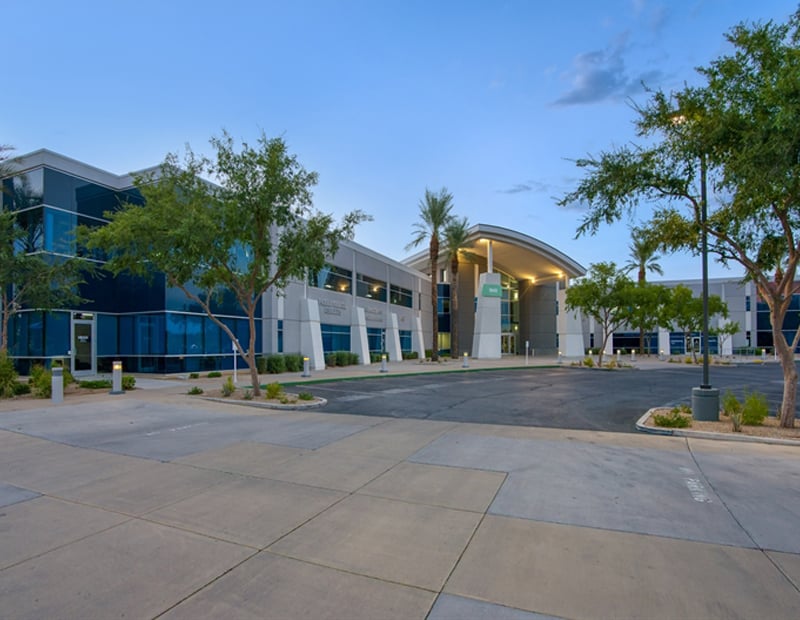
Phoenix assets traded for about $184 per square foot on average, slightly below the $195 U.S. figure. Among secondary markets, Nashville, Tenn. ($450 per square foot) commanded the highest prices, while Atlanta ($134 per square foot) and Houston ($157 per square foot) properties traded for less.
In one of the largest sales in the metro so far this year, RX Health & Science Trust paid $48 million for Stapley Medical Center, a 181,710-square-foot medical office campus in Mesa, Ariz. Harbert Management Corp. and Cypress Office Properties LLC sold the asset for about $264 per square foot, well above the metro’s average.
Pipeline stays moderate as deliveries rise
Phoenix’s office development pipeline comprised 583,552 square feet as of June. Tampa, Fla. (346,000 square feet) and Atlanta (380,000 square feet) are some of the peer metros that had less space underway, while Dallas (2.9 million square feet) and Austin (1.3 million square feet) posted some of the largest pipelines. Boston (3.4 million square feet) led nationally.
The metro’s underway square footage accounted for 0.4 percent of its total office stock, on par with the U.S. figure and markets such as Denver, Tampa and New Jersey. When also taking into consideration its planned projects, this share rose to 1.8 percent, slightly above the national threshold.

One of the largest projects currently underway is Project Paradise, Arizona Cardinals’ 250,000-square-foot headquarters. Mortenson is developing the building scheduled to come online in June 2028, which will also double as a training facility. The development is rising within a 217-acre, mixed-use project.
In terms of deliveries, Phoenix saw four office completions totaling 357,772 square feet in the first half of the year. This represented a 59.3 percent year-over-year increase. U.S. Realty Advisors’ 5353 East City North Drive is the largest to come online, consisting of 265,626 square feet. Republic Services fully leased the property.
Vacancy remains below U.S. average
Phoenix’s office vacancy rate stood at 16.5 percent as of June, down 60 basis points year-over-year. The figure was also 120 basis points below the 17.7 percent national average. Dallas (19.2 percent), Austin, Texas (24.5 percent) and Houston (23.3 percent) had more available space. Tampa(14.3 percent) was the only peer metro with a lower rate.

At the beginning of this year, Banner Health downsized its corporate headquarters in Phoenix. The company will move from its current space totaling 304,000 square feet at Phoenix Plaza to 67,000 square feet at Bond Phoenix by the end of the year. The firm will reduce its administrative costs to better focus resources on its health care mission.
Additionally, the average listing rate for Phoenix office space during the same month was $29.58, marking a 2.5 percent increase compared to a year ago. Still, the metro remained among the more affordable major U.S. office markets. By comparison, Austin averaged $46.93 per square foot, while Atlanta reached $36.64 per square foot.
Coworking inventory remains steady
As of June, Phoenix’s coworking inventory totaled 3.6 million square feet across 185 locations, according to CoworkingCafe. That represented 2.4 percent of the metro’s total office stock, slightly above the 2.3 percent national average and in line with Dallas.
By square footage, Phoenix ranked in the middle of its peer set. Dallas (6.9 million square feet) and Atlanta (5.8 million square feet) had larger coworking footprints, while Austin (2.1 million square feet) and Tampa (2 million square feet) remained on the lower end.
Phoenix’s five largest flex office providers were unchanged from previous coverage, although rankings shifted. Regus kept the largest footprint at 611,402 square feet across 34 locations, followed by Industrious (259,344 square feet) and Spaces (241,820 square feet). However, Arizona State University grew its footprint to 198,817 square feet, surpassing Bellagio Executive Plaza (178,430 square feet).



You must be logged in to post a comment.