
SIOR Special Report: How to Dominate the Data Center Market
Developers are becoming a dime a dozen. But they can still stand out.
Data center development and leasing presents a paradox of sorts for developers, owners and operators. While it spreads to markets with little previous exposure to the property type alongside insatiable demand, the ability to adequately allocate utilities and improve the public’s perception of the facilities is proving to be a difficult tightrope to walk. But it is indeed possible to thread this needle.
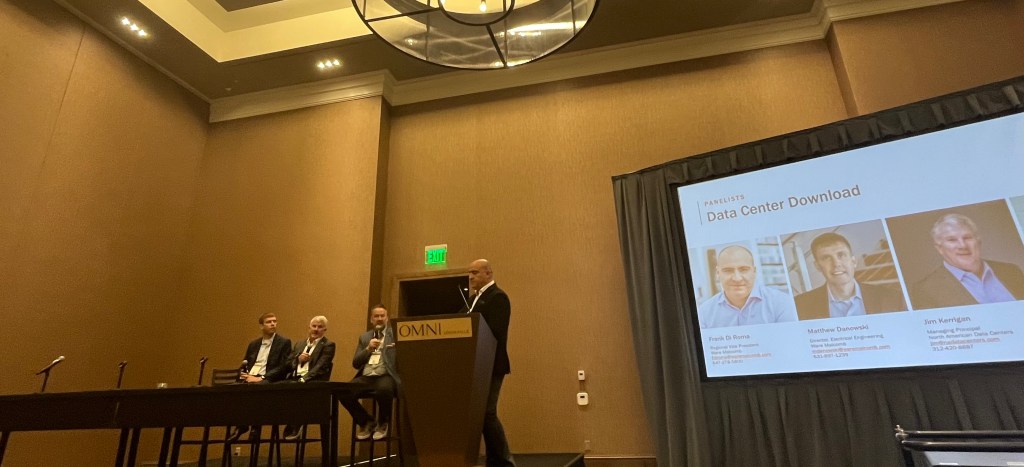
A panel of experts leading a discussion called Data Center Download at the Society of Industrial and Office Realtors’ 2025 CREate360 conference hosted in Louisville, Ky., provided tips on the best practices for accomplishing the above. According to the speakers, being both flexible with utilities and communicative to locals will yield net benefits to both the builders and the communities they operate in.
Challenges and changes
Despite the extant strong demand from companies of all shapes and sizes, the ability to supply and cool data centers externally remains limited, having recently been strained further. According to the International Atomic Energy Agency, an AI-supplying hyperscale facility uses as much electricity as 100,000 single-family homes. A Berkeley Lab report from December 2024 found that these same facilities could consume anywhere between 16 and 33 billion gallons of water annually within three years.
READ ALSO: Alternative Disruptors: Right-Sizing Data Centers
“Everyone thinks we are geniuses, but in reality we are frustrated by the utilities,” said Jim Kerrigan, managing principal at North American Data Centers. “Just because you see high-voltage lines traveling through doesn’t mean they like it.” The industry has reached the point where it can no longer rely solely on external providers for data center needs. “With all these power crises, we need it both on site, and temporary generation.”
And it’s not just energy needs that are the hallmarks of the sector’s increased diversity. “My normal clients were once Fortune 500 companies, and they required about five to seven kilowatts per cabinet. Now, they are over 20 per cabinet” Kerrigan added. These requirements will only increase, as companies like CoreWeave rapidly grow their share in the cloud computing market.
Positive externalities
The biggest effects of these changes? Developers are now building wherever possible, as opposed to the five or six core markets of old. But almost all data center developers have come to the same realization. “Just because you have a great site, the guy next door has a better site,” Kerrigan noted.
This is why strong relationships with utilities are so crucial to winning site bidding wars. “You need to have a good power story in order to advance any project,” advised Todd Johnson, director of real estate for Ryan Cos.’ Mission Critical sector. “That could be hearsay, past studies, what the utility company says or, God willing, landing a substation next to it,” Johnson detailed.
Currying the favor of utility companies is only half the battle; local residents need to be on board as well. According to panelists, their objections to the facilities’ energy expenditure and noise are warranted, but they should be made aware of the added jobs and infrastructure improvements the facilities provide. “Our industry has done a terrible job at educating the public about what’s going on (at) data centers,” Kerrigan said. “Once they’re built, there are a ton of new homes, roads and schools.”
Developers would do well to work with, not against the locals. “In a core metro, nobody is going to pay you more for land than a data center,” Johnson concluded.


You must be logged in to post a comment.