

Net Lease Investment Holds Steady
Investors are eyeing anticipated cuts by the Fed.
Investor demand for U.S. net lease properties remained stable during the third quarter of 2025, along with pricing, though transaction volume still lags historical peaks, according to The Boulder Group’s latest net lease market report.
“There’s growing investor optimism based on two interest rate cut expectations,” Boulder Group President Randy Blankstein told Commercial Property Executive. “There has also been a narrowing of the bid/ask spread.”
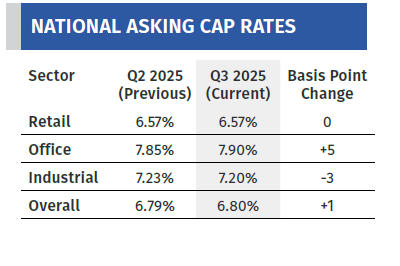
Overall cap rates increased by just a single basis point to 6.8 percent in the third quarter compared with the second quarter, in line with broader commercial property market trends. This minimal movement reinforces the market stabilization of the second quarter, the report noted.
READ ALSO: 4 Reasons Investors Turn to Net Lease

Among the net lease property types, there was also little movement in cap rates quarter-over-quarter. Retail cap rates were unchanged at 6.57 percent. Office cap rates increased to 7.9 percent (up 5 basis points), while industrial cap rates compressed by 3 basis points to 7.2 percent.
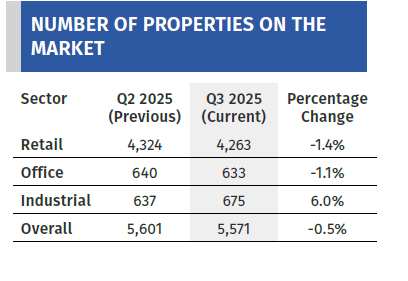
The supply of net lease properties nationwide didn’t budge much either in the third quarter, according to Boulder, with one exception. Overall, there was a 0.5 percent decrease in overall market supply. Retail and office inventory dropped 1.4 percent and 1.1 percent respectively.
On the other hand, the supply of industrial properties on the market increased by 6 percent, which suggests increased seller activity for that property type.
Blankstein also noted that there has been strong individual demand for gas stations, in the wake of the Big Beautiful Bill, due to the restoration of 100 percent bonus depreciation in that legislation.
Investors can now claim 100 percent bonus depreciation with no expiration date, with gas stations as one of the few net lease asset types that consistently qualify for that tax advantage. Bonus depreciation had been scheduled to drop to 40 percent this year, and down to zero by 2027, but Congress restored the full bonus depreciation.
Overall, buyers and sellers also seem to be more in sync regarding pricing, with the bid-ask spread remaining narrow in the net lease sector, according to Boulder.
The spread between asking and closed cap rates tightened to 29 basis points (down only 1 basis point) for retail properties. Industrial spreads widened slightly, but remained at levels similar to the retail sector, at 30 basis points (up 3 basis points).
Interest rate movement anticipated
As of the beginning of the fourth quarter of 2025, the Federal Reserve has scheduled two more meetings this year of the Federal Open Market Committee, which determines the lead Federal Funds rate. FOMC made a 0.25 percent rate cut earlier this year.
Institutional demand for net lease properties remains high, with the current cost of capital as the prime variable for salability, according to Boulder. Thus net lease investors—like all real estate investors—are carefully monitoring the policy of the Fed.
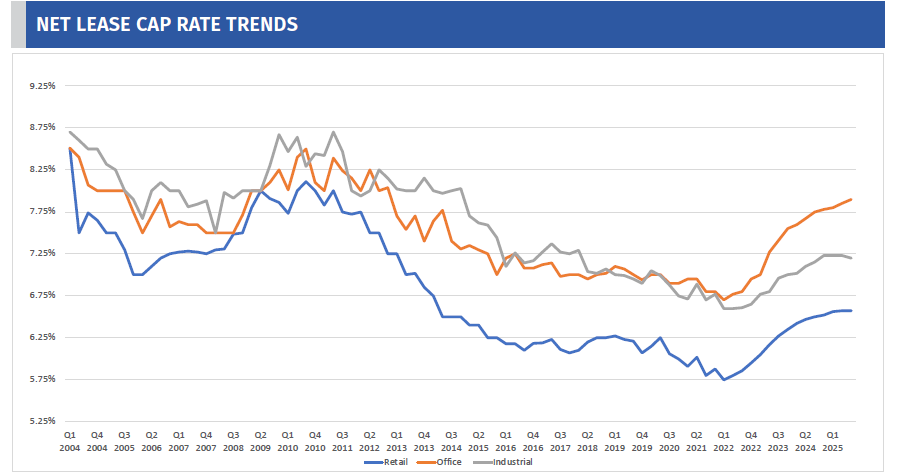
If rate cuts continue, the net lease market would benefit, the Boulder report noted. However, historically cap rates have not moved precisely in lock step with interest rates, since supply and demand drives pricing in the market as well.




You must be logged in to post a comment.