
Inside Industrial: Why Cold Storage Is Becoming More Specialized
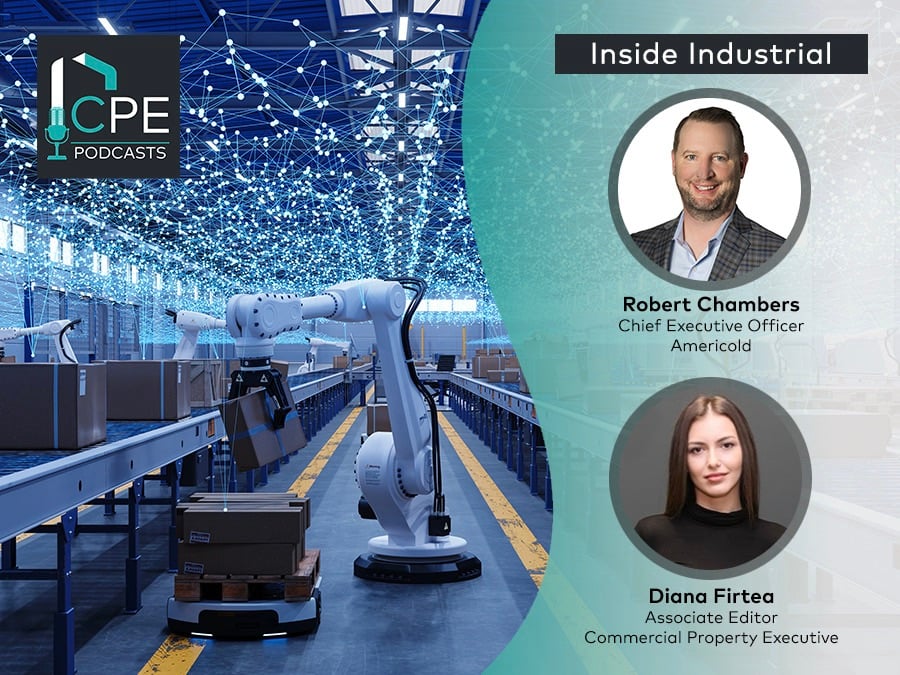
Americold CEO Rob Chambers joins CPE’s Diana Firtea to discuss slowing development, facility upgrades and the changing requirements shaping cold storage.
Cold storage is still working through the supply added after the pandemic. U.S. vacancy reached 7.7 percent in the first half of 2026, when the sector recorded its first negative first-half net absorption since 2007, according to Newmark.
But development is already slowing. Americold CEO Rob Chambers said new starts have fallen significantly, project announcements have nearly come to a standstill and customer inventories have largely aligned with demand following a period of destocking.
In the fifth episode of Inside Industrial, Chambers joined CPE’s Diana Firtea to discuss how those shifts are changing cold-storage development, what keeps older facilities competitive, where automation fits and why changing customer requirements are making the sector increasingly specialized.
LISTEN TO: The Learning Curve: Still Learning While Leading
For decades, cold storage added roughly 1 percent of stock annually, Chambers said, before supply jumped to about 4 percent per year for four years following the pandemic. With that capacity now being absorbed, new construction is slowing and is increasingly tied to dedicated customers or specialized capabilities. Americold’s Plover, Wis., facility for McCain Foods, backed by a 20-year commitment, is one example.
Older facilities can still remain competitive with continued investment in refrigeration, energy efficiency and selective automation. Fully automated systems, however, are generally better suited to buildings designed from the ground up. Chambers also expects future cold-storage facilities to become more specialized as food safety, e-commerce and other customer requirements evolve, while temperature-controlled logistics could expand into sectors such as pharmaceuticals, aerospace, defense and data centers.
Here’s a summary of the discussion:
- (02:00) How cold-storage supply and demand have changed over the past six to 12 months
- (05:03) Why new development is slowing and where new construction still makes sense
- (07:21) What it takes to keep older cold-storage facilities competitive
- (09:29) Where automation can improve conventional buildings and when ground-up development is necessary
- (11:25) How food safety, service expectations and e-commerce are changing customer requirements
- (14:16) Why future facilities will need more specialized capabilities across different supply-chain nodes
- (17:49) Cold storage’s role as mission-critical infrastructure and where temperature-controlled logistics could expand next
Follow, rate and review CPE’s podcasts on Spotify and Apple Podcasts and don’t forget to subscribe to CPE’s YouTube channel!
Music credit: Meeting with the Sun via stocktune.com
You must be logged in to post a comment.