


Corporate Real Estate Wrestles With Costs, AI Adoption
Check out the latest update on the industry’s priorities and challenges.
Corporate real estate managers have a lot on their minds these days, but some concerns stand out—and will continue to do so in 2026, according to a new report by JLL.
Cost-control is still the top worry, but commercial real estate managers are also grappling with ‘elastic’ workplaces and the evolution of experiential-centric workplaces, taking AI to the next level and maintaining sustainability efforts.
Nearly three-quarters (72 percent) of commercial real estate teams cited reducing operating costs as a top priority, far ahead of optimizing office space, which just over half (51 percent) cited that as a top priority, according to JLL. Slightly fewer (50 percent) said that achieving organizational efficiency was a top priority.
Other top priorities, JLL noted, include sustainability and employee experience (both 34 percent), consistent with broader trends in commercial real estate. At the other end of the spectrum, only 7 percent said they would be expanding office space footprints for increased return-to-office.
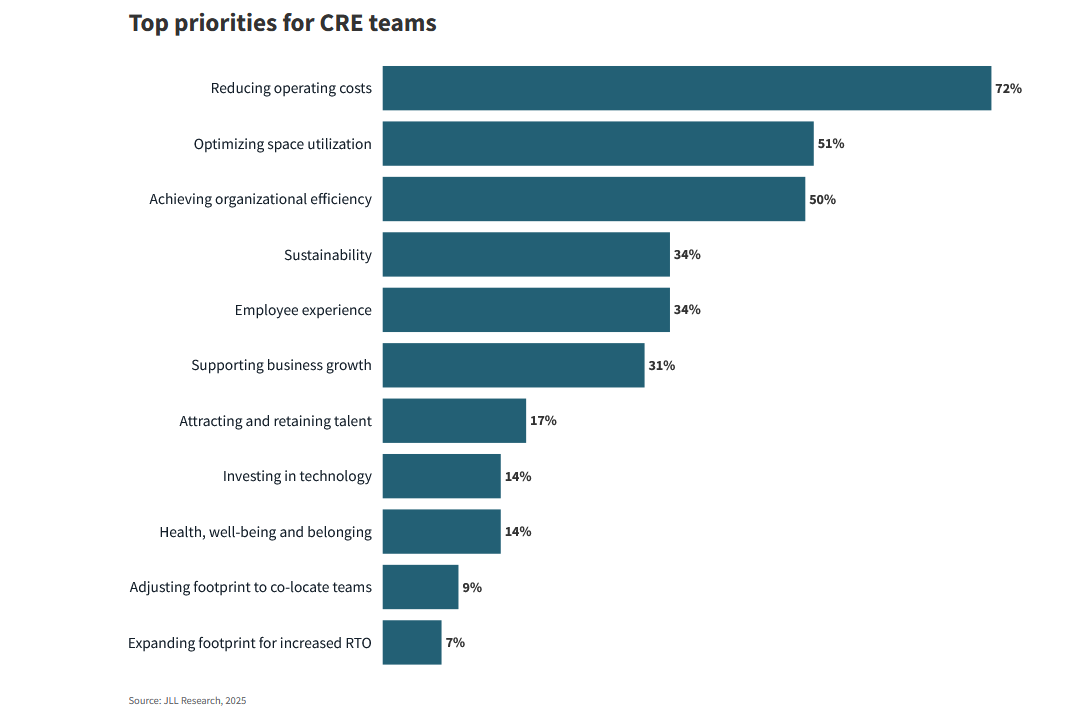
While 72 percent of organizations remain focused on cutting costs, those that reinvest some of these savings in technology, employee experience, and flexibility will create real competitive advantage, Paul Morgan, global COO, real estate management services at JLL, told Commercial Property Executive.
Trends in corporate real estate in ‘26
One main trend to watch next year in the corporate real estate sphere is the concept of “elastic portfolios,” which flex across asset types to meet organizational goals, the report detailed.
By combining core headquarters, satellite hubs and on-demand flex spaces, adaptable workplace models become more achievable. Elasticity is facilitated by real-time portfolio data, which enables the quick optimization of office space in response to changing business needs.
With office utilization averaging 54 percent globally, it is still falling way short of targets, Morgan noted. Yet, rather than downsizing, 43 percent of corporate leaders project their headcount to grow and a third report they plan to expand their footprints.
READ ALSO: What’s Driving Corporate Office Moves
“That’s why we’re seeing this urgent shift toward ‘elastic portfolios,’ which are essentially real estate strategies that can bend and flex instead of being locked into rigid, long-term commitments,” Morgan said.
Fixed footprints are financially inefficient. “AI job shifts and volatile project cycles call for variable capacity without long-term commitments, requiring elastic portfolio models that consider both physical and operational adaptability,” the report pointed out.
The improvement of the office experience is another important trend. People who come to the workplace feel it is worth the commute; not coming in correlates with poor comfort, limited autonomy and weak well-being support, JLL wrote. People aren’t rejecting the office, but they do bristle at bad office experiences and poor locations.
Site selection strategies will focus on vibrant places, as well as workplace programs providing discounts to local amenities or events. Such locations improve overall employee experience.
“Companies that figure out how to balance cost savings with great employee experiences, and blend AI with human-centered design, are turning their real estate into a secret weapon for attracting talent and staying competitive,” Morgan said.
What’s next for AI?
A new frontier for corporate real estate involves the integration of advanced AI into building systems and workplace platforms, creating responsive environments that adapt in real-time data to user needs.
The AI revolution is happening faster than anyone expected, Morgan said.
Fewer than 5 percent of CRE teams planned AI pilots in 2023, while 92 percent did so in 2025. The practical applications for facilities management means AI can potentially cut energy and maintenance costs by 10 percent to 30 percent through predictive controls.
“It all comes down to data,” Morgan said. “High-quality, connected data is what makes all of this possible. It’s the thread that ties together all major trends we’re tracking.”
Sensor networks, access control, Wi-Fi analytics and booking systems now provide rich data streams that AI can use to detail actionable insights.
However, organizing this fragmented information remains a major challenge according to the report. The bottleneck is foundational, with 54 percent citing compatibility issues with legacy infrastructure as the top barrier, the report noted.
Other challenges for corporate real estate
Next year, corporate real estate will also face other challenges, some stemming from the adoption of digital tools and AI. That change is altering the required skills and mindsets that facilities management teams need, the report posited. Re-skilling existing employees and bringing in new digital-first talent are now as critical as cost efficiency or process excellence.
Another challenge: a growing share of properties faces one kind of obsolescence or another that threatens asset values. For commercial real estate leaders, these risks are compounded by energy cost increases, which have accelerated in the last four years.
Thus, robust energy management is an urgent business priority, JLL found. Yet many organizations still lack comprehensive mechanisms to measure and optimize utility consumption on a recurring basis.
Effective energy management would not only unlock direct cost savings, according to the report. It also provides the credible data required for compliance with sustainability regulations, which aren’t going away.




You must be logged in to post a comment.