

Why Net Lease Investing Is ‘All About the Real Estate’
Amid uncertainty, net lease is the new darling. But not every deal delivers the same level of security.

A volatile investment environment marked by high interest rates, geopolitical strife, rising inflation and a fluctuating stock market is driving a run-up in net lease investment.
“Investors are gravitating toward strategies that blend value-add upside with core-like income characteristics,” said Todd Stender, managing director at LNL Capital, which specializes in financing net lease assets. “In that context, net lease stands out.”
Not all net lease is created equal, however. Higher borrowing costs, uneven property performance and overall economic uncertainty require investors to be extra-discerning about tenant credit and the residual value of the real estate.
Net lease is having a moment
Net lease was once considered a fixed-asset investment like bonds and Treasuries. That mindset changed when retailers that were incredibly strong 10 years ago, like Walgreens and Bed Bath & Beyond, experienced shifts in their markets that affected the strength of their business and investment profile, noted Josh Dicker, an associate vice president with Northmarq’s Chicago office.
Now both private and institutional investors are zeroing in on net lease’s underlying real estate advantages relative to fixed-income assets, including stable, long-term, passive investment opportunities. Long-term, triple-net lease contracts and built-in rent escalators insulate assets from inflation and cyclical market volatility. Net leases also minimize vacancy risk, eliminate tenant improvement costs and shift responsibility for operating costs—taxes, insurance and property maintenance—to the tenant.
Green Street’s monthly Commercial Property Price Index revealed that net lease assets outperform other property types in cyclical downturns. For example, the Net Lease Index declined 7.6 percent in reaction to the COVID-19 pandemic, compared to the 11.2 percent drop in the All-Property Index. The Fed’s tightening of interest rates resulted in net lease declining 18.6 percent, while the All-Property Index fell 21.4 percent.

Today, sophisticated allocators recognize that NNN can generate favorable risk-adjusted returns compared to corporate bonds due to the residual value of hard assets and legal protections of lease affirmation in bankruptcy, according to an LNL Capital white paper.
Private investors, which include 1031-exchange investors, retirement-age seniors, family offices, private funds and high-net-worth individuals, are the most active participants in net lease investment, according to a CBRE report. Private investment was up 30 percent year-over-year in Q4 2025, with $9.1 billion in investment representing roughly 57 percent of the quarter’s $16.0 billion total.
Institutional investors, which have long valued net lease for its long-term leases and compelling risk-adjusted returns, have also increased their participation in net lease since 2020 and now are the second-largest capital source, comprising about 27 percent of NNN acquisition volume per year on average, noted Sharrin.
Large recent commitments include Blue Owl purchasing Sila Realty Trust, a net lease REIT with properties in health care and medical office, for $2.5 billion in July, and Goldman Sachs Asset Management agreeing to buy LCN Capital Partners, an investment manager specializing in sale-leasebacks, build-to-suits and triple-net leases with $3 billion in assets. Single-asset net lease transactions are also on the rise across numerous business sectors.
Net lease investments can be more sensitive to benchmark interest rates than other commercial real estate asset classes, and there is a binary risk: If the tenant vacates, income stops, noted William Pike, CBRE’s president of U.S. Industrial & Logistics Capital Markets and leader of CBRE National Partners.
“That said, the structural advantages of the asset class far outweigh the risks for most investors, particularly when assets are underwritten carefully and tenants are well-credentialed,” Pike noted.
Where yields are strongest
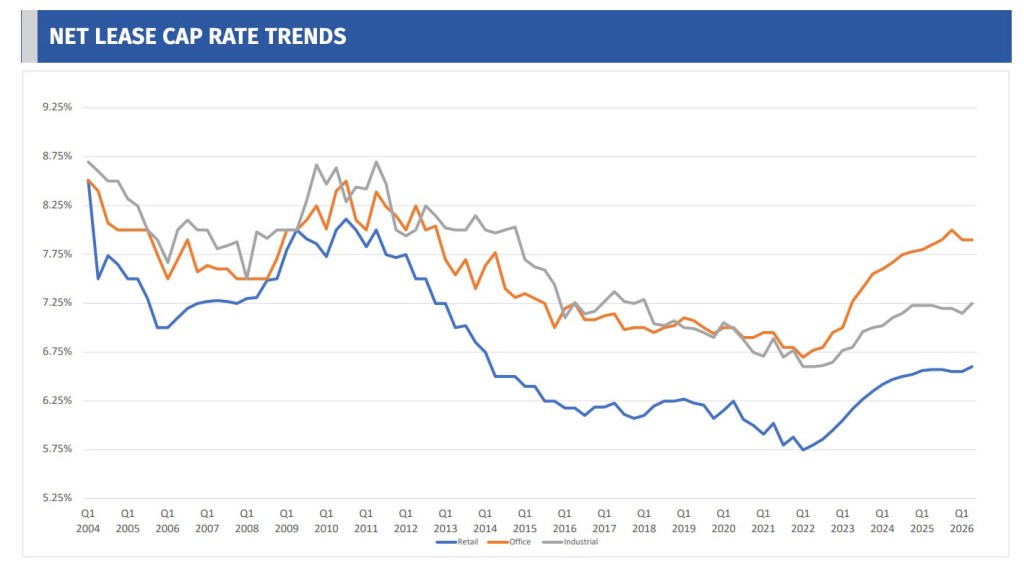
Currently, industrial net lease assets supported by long-term drivers like e-commerce, logistics growth and reshoring of manufacturing are delivering some of the strongest risk-adjusted yields. As of the second quarter, single-tenant industrial net lease cap rates averaged 7.25 percent, according to a Boulder Group Q2 net lease market report.
Essential and mission-critical retail offers somewhat lower yields but still provides stability supported by resilient tenant demand and recurring consumer needs. As of Q2, single-tenant net lease retail cap rates averaged 6.60 percent, reported the Boulder Group.
Beyond the yield
But yield should not be the only measure when considering a net lease investment, sources say.
“Our approach is to prioritize defensive net-lease structures with investment-grade tenants, essential uses and durable locations rather than reaching for yield,” Stender said.
Jonathan Hipp, a principal at Avison Young who heads the net lease practice, said focusing on yield first and the real estate second is the biggest mistake investors make.
“A 7 cap rate isn’t necessarily better than a 5 cap rate if the 7 cap rate has a mediocre location and a weak residual value,” Hipp suggested.

Beyond the corporate logo

Alex Sharrin, JLL senior managing director & co-lead of the firm’s Corporate Capital Markets & Net Lease Team, said the best net lease investments are assets with investment-grade or strong regional-credit tenants, 10-plus years of remaining term, below-market rent or a lease with contractual bumps and a location that would lease up quickly if the current tenant leaves.
“My rule is to underwrite the real estate as if the lease disappears tomorrow,” he said. “If the answer is ‘it’s worth a lot less,’ that’s the risk you’re actually pricing.”
For retail, the business model is critical to the tenant’s staying power. For example, Hipp suggested, if the tenant is a deteriorating concept like a video store in today’s market, it means taking on more risk.
Retail is also location dependent. “Fungible properties in densely populated, high-traffic markets tend to weather downturns best,” said Stender.
For Hipp, it’s all about how productive the location is, the rent-to-sales ratio and how difficult it is for the tenant to relocate. “I like mission-critical locations—like good submarkets that are not only growing but have good demographics,” he said.
LNL also looks “closely at a tenant’s ability to sustainably meet its triple-net obligations,” Stender said, “as well as the remaining lease term and the likelihood of renewal at expiration.”
Alex Sharrin, senior managing director & co-lead of the Corporate Capital Markets & Net Lease Team at JLL Capital Markets, suggested that the tenant’s unit-level economics are more important than the corporate logo. A profitable location backed by a struggling brand can outlast a strong brand in an unproductive location.
Obtaining financials for public companies is easier than for private companies because their credit ratings and debts are listed on Moody’s and the S&P. But successful private companies, like Chick-fil-A, Sheetz and Wawa, are considered investment-grade and are some of the most active and heavily traded in the net lease market.
It’s important for investors to separate retail risks from tenant risk, Hipp said. “A grocery-anchored center is retail, and so is a quick-service restaurant, but a QSR is not necessity or service-driven,” he explained. Grocery-anchored centers fill other needs besides groceries because they have ancillary retail, such as cleaners, nail salons, QSRs, pharmacies and medical offices.
Buyers, Hipp said, should also beware of big-box retailers, which have dramatically different profiles than 10 years ago, with appliance stores like Circuit City and Best Buy having over-expanded. “This isn’t a bad industry; they just weren’t run properly,” Hipp said.
But a desirable piece of real estate will always provide a backstop. “People who want to buy a passive long-term investment to collect cash flows should focus on high-quality real estate, with good access and ingress, as even quality-credit tenants can eventually stumble,” he said.
Minimizing net lease risk

The greater scrutiny is showing up in how investors underwrite properties. Sharrin identified several key factors his team considers when evaluating net lease assets:
How important is the location to the tenant? Is it a flagship, high-volume store or a fill-in unit that would be cut first in downsizing?
How durable is the business plan? Will it last throughout the lease term or is it a short-lived trend or fad that can’t sustain long-term profitability?
What is the property worth without the tenant? If you underwrite the real estate value on an “as-vacant” or “dark” basis—land value, alternative use, and re-tenanting potential at market rent, does it only pencil with the existing tenant’s specific rent and use? That’s a red flag for term-end value.
What happens if the tenant doesn’t renew? Does the property still support financing and sale at a reasonable basis?






You must be logged in to post a comment.