


REITWeek Special Report: The Allure of Data Centers, Health Care
CEOs and investors are leaning into these property types.
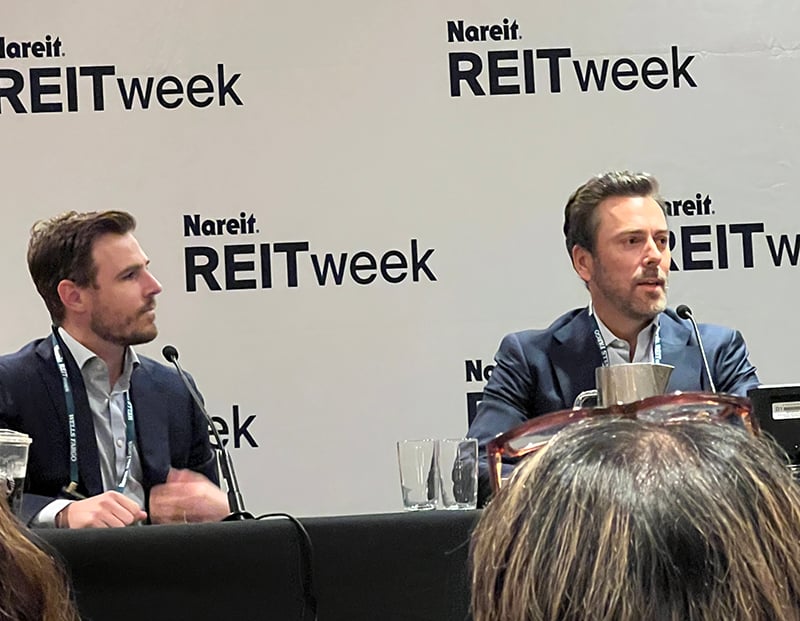
During NAREIT’s REIT Week conference, REIT executives get 30 minutes to tell their companies’ stories to investors, analysts and others. Yesterday, on the first of two days of presentations, the best-attended presentation was delivered by a company that doesn’t own any assets yet.
Blackstone Digital Infrastructure Trust is a blind trust REIT that went public last month with a $1.7 billion IPO. The newly minted externally-managed company plans to use all the tools in Blackstone’s toolkit to buy and hold recently stabilized data centers leased to investment-grade hyperscalers in top-tier markets.
BXDC CEO & President Nick Pell, who previously served as the president & CIO of Link Logistics, said the company’s current “buy box” is $100 billion, but the total addressable market is expected to be over a $1 trillion by 2030.
READ ALSO: How Significant Is the Backlash Against Data Centers?
“We think the runway for growth for this company is massive,” Pell said.
BXDC may be compared to net lease REITs, Pell said, but it is “more like a data center REIT that happens to be net lease” because the fixed escalations in the data center leases are better than a lot of net leases.
CFO Tony Marone said Blackstone chose the blind trust structure for “speed to market.” It chose public execution because the long-term horizon of the assets was a mismatch for private equity vehicles, the scale of these investments would need deep access to capital and the public markets are enthusiastic about AI and data centers. Also, Blackstone thought REIT investors would like the low-risk profile of the targeted investments.

That appetite for data center investment shows in NAREIT’s data. The organization’s active manager tracker, which monitors quarterly investment holdings of the largest actively managed real estate investment funds focused on REIT investment, found data centers saw the largest quarterly and yearly increases of all the property sectors, with 139 percent of its FTSE Nareit All Equity Index weight in the funds. Meanwhile, among the four traditional property types, industrial, retail and residential were all underweighted in active managers’ portfolios when compared with the index. Only office was overweighted at 114 percent.
Health care continued to hold the top spot for active managers at 19.4 percent of assets under management. In a show of strength for that property type, senior living REIT Janus Living, a spinoff of Healthpeak Properties, launched with an $878 million IPO in March and, at the end of May, it held a new public offering of 25 million shares of common stock to fund further acquisitions.
Data centers were second at 18.4 percent (up 3.3 percentage points), and retail was 13.6 percent. Telecommunications fell to 12.2 percent, while residential dropped to 10.9 percent to 1.3 percent of assets.
Multiple opportunities
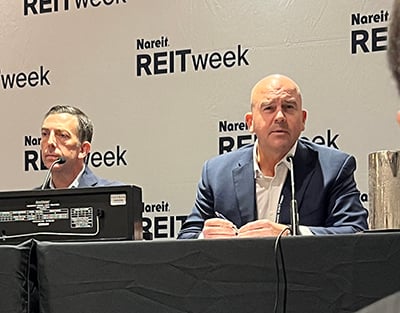
Prologis is not a data center REIT, but during its 30-minute spot, CEO Dan Letter emphasized how the company is committed to expanding its presence in that market through its tremendous land resources, its development capabilities, its energy business and its existing portfolio in the “highest-quality and highest-barrier markets.”
In addition to serving data center tenants, Letter noted, 10 percent of recent leases have been to suppliers focused on the data center buildout in markets like Texas, Illinois and Virginia.
“We see this as a potential, growing demand driver,” he said.





You must be logged in to post a comment.