


Houston’s Office Vacancy Rate Drops, Prices Remain Low
Find out how the metro fared at the end of 2025, based on Yardi Matrix data.
Houston’s office figures remained steady until the end of the year. As of November, the metro’s office vacancy rate continued to drop, while still surpassing the national average, according to Yardi Matrix information.
The metro’s underway pipeline remained stable, with fundamentals ranking midrange among peer markets. Medical outpatient facilities remain a hotspot for investors and developers alike, supported by consistent demand from health systems. These dynamics align with broader medical office real estate trends that highlight consistent occupancy and long-term income growth.
However, office assets in Houston still commanded low prices. Year-to-date as of November, properties traded for $89 per square foot on average, less than half the national average, the data provider shows.
A MOB-focused inventory
Houston’s development pipeline comprised just north of 1 million square feet underway, according to Yardi Matrix data. The metro ranked fourth in the southern region.
Dallas (2.6 million square feet) and Austin, Texas (1.5 million square feet) are some of the peer markets that fared better. Atlanta (879,600 square feet) and Denver (604,628 square feet) had less space under construction.
This fall, the University of Texas MD Anderson Cancer Center broke ground on 7510 Bertner Ave., a 281,254-square-foot office building. The R&D facility is scheduled to come online in 2028 near the Texas Medical Center. As of June, the metro had the largest inventory of medical office space nationwide.

In terms of deliveries, Houston had 16 office completions year-to-date as of November. These projects totaled 1.1 million square feet and accounted for 0.4 percent of the metro’s total inventory, slightly below the national average.
One of the largest facilities to come online was Welltower’s 256,452-square-foot medical outpatient facility at 8503 N. Sam Houston Parkway E. in Humble, Texas. Kelsey-Seybold Clinic occupies space at the five-story building.
Investment steadies, prices remain low
Houston office space sales activity totaled $1.1 billion year-to-date as of November. Assets in the metro changed hands for about $89 per square foot on average, less than half the $190 per square foot U.S. figure.
Nationally, Manhattan continued to lead with $7.3 billion. Among peer metros, Dallas ($2.6 billion) and Atlanta ($1.3 billion) surpassed Houston, while Denver ($1 billion) was right behind.
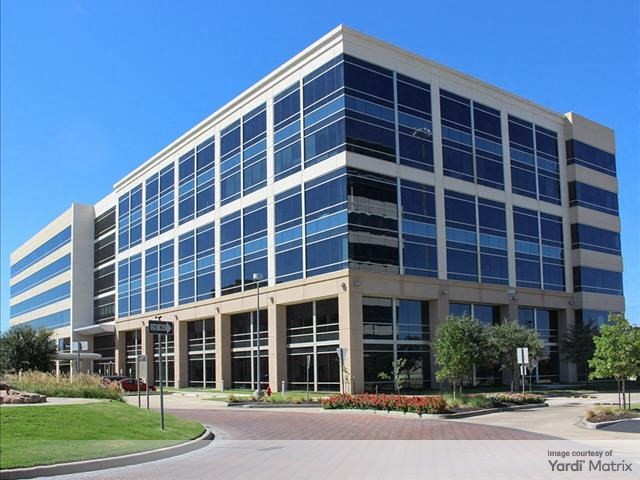
In August, MetroNational acquired the former Marathon Oil headquarters, a 442,000-square-foot building in the CityCentre district. The deal marks the company’s largest acquisition in a decade. ConocoPhilips, which acquired and absorbed Marathon Oil in November last year, sold the asset.
During the same month, Invesco sold Energy Crossing I, a 240,166-square-foot office property within the Energy Corridor. Capital Commercial Investments purchased the three-story facility nine months after purchasing another building within the same campus.
Houston’s vacancy rate drops, still above national figures
As of November, Houston’s vacancy rate clocked in at 20.2 percent, dropping 410 basis points year-over-year. Despite that, the metro’s figure was still above the national average, which dropped to 18.5 percent.
In October, Norton Rose Fulbright renewed and expanded its headquarters agreement at Skanska’s Norton Rose Fulbright Tower. The firm will now occupy 139,000 square feet at the 382,000-square-foot, 28-story tower.

Other notable deals include law firm Wright Close & Barger LLC’s commitment to a 41,000-square-foot headquarters lease at TC Energy Center, a 1.3 million-square-foot tower. M-M owns the LEED Gold-certified, 56-story high-rise since 2008.
The average listing rates for office space in Houston as of November clocked in at $27.6. This figure was half the $54.9 national average and lagged behind most of its peer markets, including Denver ($29.3), Phoenix ($29.8) and Dallas ($32.2). The metro’s index dropped 8.7 percent year-over-year.
Coworking sector shows steady fundamentals
As of November, Houston had roughly 5 million square feet of shared space, according to CoworkingCafe. This made up 2 percent of the market’s office inventory, 20 basis points below the national threshold.
Peer markets such as Atlanta (2.6 percent), Denver (2.4 percent) and Phoenix (2.2 percent) showed larger shares. At the opposite end were Philadelphia (1.7 percent) and Austin (1.9 percent).
Regus had the most coworking space, with 657,372 square feet across 40 locations. The company was followed by The Cannon (442,937 square feet) and Workstyle Flexible Spaces (427,464 square feet).

You must be logged in to post a comment.