


Top STEM Hubs Fueling CRE Demand
And which ones are no longer on the list.
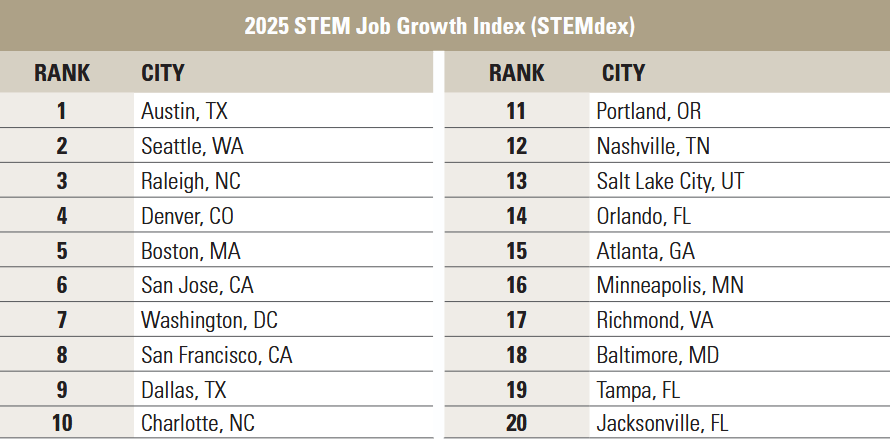
The top slot in the STEM Job Growth Index (STEMdex) once again goes to Austin, Texas, in a ranking published annually by RCLCO. That means that the city has, and has long had, the strongest prospects for employment and industry expansion in the Science, Technology, Engineering and Mathematics industries.

For the seventh time in nine years, Austin is the U.S. STEM king. The metro has the employment base for it: More than 11 percent of jobs in Austin are in STEM fields, nearly double the national average, the report noted.
Moreover, the STEM employment growth in Austin has been rapid, up an average of 3.2 percent annually over the last five years. The metro also remains near the top in the report’s Workforce Quality and Quality of Life metrics.
The next top markets are familiar players in the tech world: Seattle; Raleigh, N.C.; Denver and Boston, from number two to number five. Despite high housing costs, Seattle remains a major employer in AI, cloud computing, gaming and e-commerce, and has a strong startup ecosystem. Raleigh, a more affordable place for STEM workers, is focused on biotechnology, software development and data analytics.
READ ALSO: Key Expectations for 2026
Denver has a strong mix of startups and established firms in aerospace, cybersecurity and renewable energy, the report explained. Boston STEM employment is thriving, despite high costs, and the city remains a leader in biotechnology, robotics and AI.
Other cities in the top 10 of the STEMdex include, from numbers six to 10, San Jose, Calif.; Washington, D.C.; San Francisco; Dallas and Charlotte, N.C. This is the first time that either Dallas or Charlotte were in the top 10, RCLCO reported.
The STEMdex is based on various socioeconomic, business, and fiscal metrics—23 all together—to evaluate employment prospects in the various cities. Among others, the metrics include population growth, industry-specific growth, STEM wages, educational attainment and cost of living.
STEM employment up
From 2019 to 2024, employment in STEM roles grew by 1.9 percent nationwide, considerably more than the 0.9 percent growth in non-STEM jobs over the same period, RCLCO reported. Salaries in STEM fields averaged $112,800 annually, nearly double the $64,430 average for non-STEM jobs.
Overall, STEM industries are drivers of innovation nationwide and local economic growth, and of the associated commercial real estate footprints such as office and industrial. The jobs themselves are among the highest-paying in the country, and thus attracting a diverse, highly educated workforce—another factor in reshaping certain real estate sectors in local markets, such as retail and multifamily.
The rapid rise of generative AI, the expansion of green tech and manufacturing advances are reshaping regional economies nationwide, and are still driving STEM job creation, RCLCO noted. AI applications are now permeating nearly every sector, creating new efficiencies and business models.
At the same time, growth in renewable energy, battery storage and carbon capture is creating jobs in states such as Texas, Oklahoma, Colorado and Georgia. The CHIPS and Science Act and the Inflation Reduction Act have further accelerated the growth of STEM, strengthening the overall commercial real estate industry outlook through industrial and office development.
By contrast, some STEM jobs are disappearing. Major layoffs in the tech sector and in professional services have occurred in such employers as Target, Amazon, Duolingo and Salesforce, especially in their corporate offices. “But it remains unclear how much generative AI is driving those job losses, rather than a response to changing economic conditions,” the report said.




You must be logged in to post a comment.